Planning a road trip or business drive in a rental car? Use this rental car mileage calculator to estimate the total miles you will cover, check whether you will stay within your plan’s included allowance, and see exactly what overage fees to expect before you hand back the keys. Enter your daily mileage allowance, rental duration, expected daily driving distance, and per-mile overage rate to get an instant, itemized cost breakdown that helps you budget accurately and avoid surprise charges at the return counter.
Rental Car Mileage Calculator: Estimate Costs & Avoid Overage Fees
Calculate total rental car miles, check your mileage allowance, and project overage fees plus fuel costs before returning the vehicle.
How to Use This Calculator
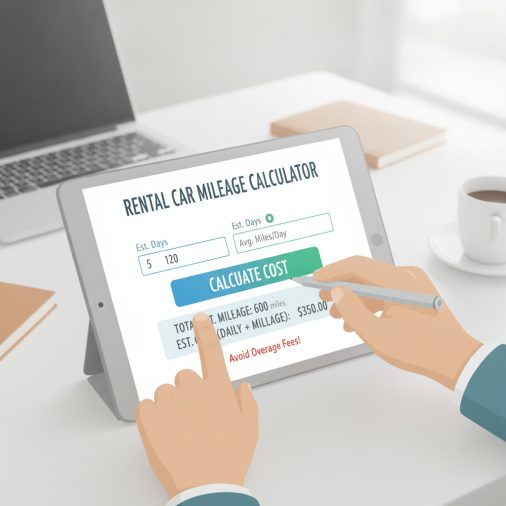
Follow these steps to get an accurate estimate from the calculator:
- Enter your rental duration — type the total number of days you will have the vehicle.
- Set your expected daily miles — estimate how far you plan to drive on an average day, including errands, sightseeing, and commuting.
- Enter your included miles per day — check your rental agreement for the daily cap; enter 0 if your plan is unlimited.
- Add the overage rate — find the per-mile fee listed in your contract for miles beyond the allowance.
- Enter the base daily rental rate — the flat daily charge before taxes and add-ons.
- Set fuel efficiency and price — use the vehicle’s EPA rating and your destination’s current pump price to estimate fuel spend.
- Read the results panel for total miles, overage miles, overage fees, fuel cost, and the grand total trip cost.
Understanding the Calculator Inputs

Rental Duration (days): Enter the total number of calendar days you will hold the vehicle, from pickup to return. Even a partial day typically counts as a full day in most rental agreements, so round up if your return time is past the pickup hour.
Expected Miles Driven Per Day: Think through each day of your trip — airport transfers, hotel-to-attraction drives, dinner runs, and any highway legs. Add those distances and divide by the number of days to get a realistic daily average. Underestimating here is the most common reason travelers face surprise overage bills.
Included Miles Per Day (0 = unlimited): Check your rental confirmation email or contract for a line that reads something like “150 miles per day included” or “unlimited mileage.” If the plan is unlimited, enter 0 and the calculator will show zero overage regardless of distance driven. If you cannot find this figure, call the rental company before pickup.
Overage Charge Per Extra Mile: This rate, typically between $0.10 and $0.50 per mile for economy cars and higher for luxury or specialty vehicles, is stated in your rental agreement. It applies to every mile beyond the daily cap multiplied by the number of rental days.
Base Rental Rate Per Day: Enter the daily rate shown on your booking confirmation, excluding taxes, airport fees, insurance, and optional add-ons. This gives you a clean base to which the calculator adds overage and fuel costs.
Vehicle Fuel Efficiency (MPG): Use the combined MPG figure from the vehicle’s window sticker or the EPA’s fuel economy database. If you are renting an SUV or truck, use a conservative estimate — real-world efficiency is often 10–15% below the EPA rating, especially with luggage and highway speeds above 70 mph.
Fuel Price Per Gallon: Check GasBuddy or a local gas station app for current prices at your destination. Prices vary significantly by state and region, so use a location-specific figure rather than a national average for the most accurate fuel cost estimate.
Understanding Your Results
Total Estimated Miles shows the complete distance you expect to drive across the entire rental period. Compare this number against your itinerary to sanity-check your daily estimate before you commit to a plan.
Total Included Miles is the cumulative mileage your rental plan covers without extra charge. If you entered 0 for included miles per day, this result will be 0, which simply means the plan is unlimited and no cap applies.
Overage Miles is the gap between what you plan to drive and what your plan covers. A result of 0 means you are safely within the allowance. Any positive number means you will owe overage fees, and you should consider whether upgrading to an unlimited plan is cheaper.
Estimated Overage Fee converts your overage miles into dollars using the per-mile rate from your contract. This is the amount that will appear as a line item on your final invoice if you drive as estimated. Even a modest overage of 50 miles at $0.30 per mile adds $15 — and longer trips can push this into the hundreds.
Estimated Fuel Cost gives you a realistic out-of-pocket fuel budget for the trip. Use this figure when comparing a prepaid fuel option offered by the rental company against paying at the pump yourself.
Total Estimated Trip Cost combines base rental charges, overage fees, and fuel into one number. This is your most useful budgeting figure and the one to use when comparing quotes from different rental companies or plan tiers.
Calculation Formulas Explained
All formulas use your input values directly. Here is how each result is calculated:
- Total Estimated Miles = rental_days × daily_miles. Straightforward multiplication of days by average daily distance.
- Total Included Miles = rental_days × included_miles_per_day. The same structure applied to the plan’s daily cap.
- Overage Miles = max((rental_days × daily_miles) − (rental_days × included_miles_per_day), 0). The max() function ensures the result never goes negative — you cannot have negative overage miles.
- Estimated Overage Fee = Overage Miles × overage_rate. A flat per-mile charge applied to every mile beyond the allowance. The calculator assumes a single flat rate with no tiered pricing.
- Estimated Fuel Cost = (rental_days × daily_miles ÷ fuel_efficiency) × fuel_price. Total miles divided by MPG gives gallons consumed; multiplying by price per gallon gives total fuel spend.
- Total Estimated Trip Cost = (base_rental_rate × rental_days) + Estimated Overage Fee + Estimated Fuel Cost. A simple sum of the three major variable costs for the rental period.
All monetary outputs are in US dollars. Travelers outside the United States should substitute their local currency values for fuel price, overage rate, and base rental rate, and convert distance inputs to miles (1 km ≈ 0.621 miles) for consistent results.
Worked Example
Scenario: A traveler rents a midsize sedan for 7 days in Florida. The rental costs $55 per day with a 100-mile-per-day allowance and a $0.30 overage rate. The vehicle gets 32 MPG and local gas costs $3.20 per gallon. The traveler expects to drive about 120 miles per day.
- Total Estimated Miles: 7 × 120 = 840 miles
- Total Included Miles: 7 × 100 = 700 miles
- Overage Miles: max(840 − 700, 0) = 140 miles
- Estimated Overage Fee: 140 × $0.30 = $42.00
- Estimated Fuel Cost: (840 ÷ 32) × $3.20 = 26.25 × $3.20 = $84.00
- Total Estimated Trip Cost: ($55 × 7) + $42.00 + $84.00 = $385 + $42 + $84 = $511.00
In this example, the traveler should check whether upgrading to an unlimited mileage plan — if available for, say, $10 more per day ($70 total) — would be cheaper than the $42 overage fee. In this case it would not be, but the comparison is worth making for longer or higher-mileage trips.
How to Interpret the Results
If your Overage Miles result is 0, you are comfortably within your plan’s allowance. Consider whether you have underestimated your driving — add a 10–15% buffer to your daily miles estimate to account for detours, wrong turns, and unplanned stops.
If your Overage Fee is more than $30–$50, compare it against the cost of upgrading to an unlimited mileage tier. Many rental companies offer unlimited plans for a modest daily premium, and the math often favors the upgrade on trips longer than five days or in destinations with spread-out attractions.
If your Total Estimated Trip Cost seems high, look at each component separately. A large fuel cost suggests considering a more fuel-efficient vehicle class. A large overage fee suggests renegotiating the plan. A large base rate suggests comparing competing rental companies using the same mileage inputs.
For families traveling with children in a rental vehicle, remember that car seat requirements still apply. Resources like car seat rules for hired vehicles can help you understand what is legally required when renting, so you can factor in whether to bring your own seat or rent one — an additional daily cost worth including in your budget.
Common Mistakes to Avoid
- Underestimating daily miles: Travelers consistently undercount driving distance by forgetting airport transfers, grocery runs, and spontaneous detours. Add at least 10% to your honest estimate.
- Ignoring the pickup and return days: Even if you pick up at noon and return the next morning, that counts as two rental days in most contracts. Make sure your rental_days input reflects the billing days, not just overnight stays.
- Assuming unlimited means truly unlimited: Some “unlimited” plans exclude certain geographic areas, one-way trips, or off-road use. Read the fine print before assuming zero overage risk.
- Using the highway MPG figure: City driving, air conditioning, and luggage weight all reduce real-world fuel efficiency. Use the combined EPA rating or go slightly lower for a conservative fuel cost estimate.
- Forgetting taxes and fees in the base rate: The calculator uses your base rate input as entered. Airport surcharges, state taxes, and insurance can add 20–40% on top of the advertised daily rate — factor those in separately when comparing total trip budgets.
- Not checking the odometer at pickup: Always photograph the odometer when you collect the vehicle. Disputes about starting mileage are easier to resolve with documented evidence.
Limitations and Important Notes
This calculator provides planning estimates only and does not constitute a binding quote or guarantee of actual rental charges. Results depend entirely on the accuracy of your inputs.
The following assumptions are built into the calculations: mileage accumulates at a consistent daily rate; setting included miles per day to 0 signals an unlimited plan with no overage; fuel efficiency is constant and does not vary between city and highway driving; overage fees are charged at a single flat rate with no tiered or capped pricing; and the base rental rate excludes all taxes, insurance, airport fees, and optional add-ons.
One-way rentals, cross-border trips, and specialty vehicles may have different mileage rules not captured here. Rental agreements vary significantly between companies and booking channels. Always verify mileage terms, overage rates, and total charges directly with your rental provider before and after the trip. The calculator is not affiliated with any rental car brand and does not access live pricing data.
Frequently Asked Questions
What happens if I go over my rental car mileage limit?
When you return the vehicle, the rental company reads the odometer and compares it to the starting mileage recorded at pickup. Any miles beyond your plan’s total included allowance are multiplied by the per-mile overage rate and added to your final invoice. This charge typically appears as a separate line item and is billed to the credit card on file. There is generally no grace period or cap on overage fees unless your contract specifically states one, so it pays to estimate carefully before you drive.
Do all rental cars have a mileage limit?
No. Many rental companies — particularly in the United States — offer unlimited mileage plans as the default for standard bookings, especially for economy and midsize vehicles on multi-day rentals. However, limited mileage plans are common for luxury cars, specialty vehicles, one-way rentals, and bookings made through certain discount channels. International rentals in Europe and Latin America are more likely to include a daily or weekly mileage cap. Always check your specific booking confirmation rather than assuming the plan type.
Is unlimited mileage really unlimited?
In most cases, yes — for standard domestic use. However, unlimited mileage plans typically exclude driving the vehicle outside the permitted geographic area (for example, taking a US rental into Canada or Mexico without prior authorization), off-road use, and commercial or rideshare purposes. Violating these exclusions can void your mileage protection and expose you to full per-mile charges or even contract termination fees. If you plan to cross a border, notify the rental company in advance and get written confirmation of the mileage terms that apply.
How do I find out my rental car's mileage allowance?
The mileage allowance is stated in your rental agreement, which you sign at the counter, and it should also appear in your booking confirmation email. Look for phrases like “150 miles per day included,” “unlimited mileage,” or “1,050 miles per week.” If the confirmation is unclear, call the rental company’s customer service line before pickup and ask them to confirm the daily or total mileage cap and the per-mile overage rate in writing. Taking a screenshot of the chat or saving the email reply gives you documentation if a dispute arises later.
Can I negotiate a higher mileage allowance before picking up the car?
Yes, and it is often easier than travelers expect. Call the rental location directly — not the national reservation line — a day or two before pickup and explain your itinerary. Many locations will upgrade you to an unlimited plan for a modest daily fee, or they may adjust the mileage cap if you explain you are driving a long route. Booking through a corporate travel account or loyalty program membership can also unlock unlimited mileage tiers that are not available on standard consumer rates. Comparing the upgrade cost against your projected overage fee using this calculator makes the decision straightforward.
What is the average overage fee per mile for major rental companies?
Overage rates vary by company, vehicle class, and rental location, but typical rates for standard vehicles in the United States range from about $0.10 to $0.35 per mile for economy and midsize cars. Luxury, premium, and specialty vehicles can carry rates of $0.50 or more per mile. Rates at airport locations tend to be slightly higher than off-airport locations. Because these figures change frequently and differ by contract type, always use the exact rate from your own rental agreement rather than an industry average when calculating potential fees.
How are overage miles tracked by rental companies?
Rental companies record the odometer reading at the time of vehicle pickup and again at return. The difference between the two readings is your total mileage for the rental period. This figure is compared against your plan’s total included miles (daily cap multiplied by rental days, or an unlimited allowance). There is no GPS tracking of your route for mileage billing purposes — only the odometer readings matter. This is why photographing the odometer at pickup is strongly recommended: it protects you if the starting mileage is recorded incorrectly.
Are mileage overage fees tax-deductible for business rentals?
For legitimate business travel, rental car costs — including mileage overage fees — are generally deductible as ordinary and necessary business expenses under IRS rules for US taxpayers. You should retain your rental agreement, final invoice, and any receipts showing the overage charges. The deduction applies to the business-use portion of the rental; if you mixed personal and business driving during the same rental period, only the business-use percentage of total costs is deductible. Consult a qualified tax professional for guidance specific to your situation, as rules vary by jurisdiction and business structure.