Use this independent Meezan Car Finance Calculator to estimate your monthly installment, total repayment amount, and total profit (markup) under a diminishing musharakah structure commonly used in Islamic car financing in Pakistan. Enter the vehicle price, your down payment percentage, financing tenure, and the annual profit rate to instantly see a breakdown of your estimated costs — including processing fees and annual insurance. Results are indicative only and do not represent an official offer from Meezan Bank or any other financial institution.
Meezan Car Finance Calculator: Monthly Payment & Profit Estimator
An independent Islamic car finance calculator that estimates monthly installments, total repayment, and total profit under a diminishing musharakah structure similar to Meezan Bank car financing in Pakistan.
How to Use This Calculator
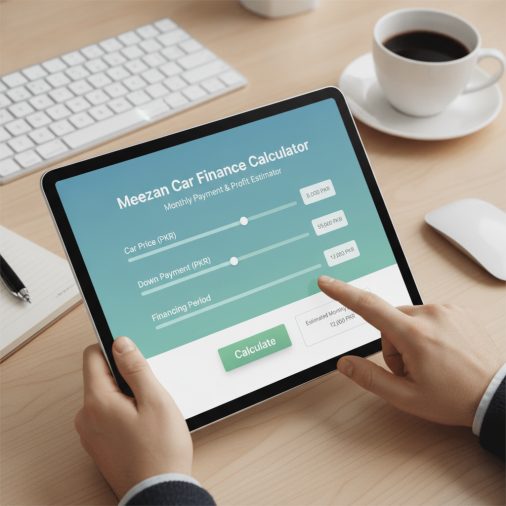
Follow these steps to get your car finance estimate:
- Enter the vehicle price in Pakistani Rupees — use the on-road price including all dealer charges.
- Set your down payment percentage using the slider. A higher down payment reduces your financed amount and total profit paid.
- Select your financing tenure from 1 to 7 years. Longer tenures lower monthly payments but increase total profit.
- Adjust the annual profit rate to match the rate quoted by your bank or use the default as a current market estimate.
- Set the processing fee percentage — typically 1% of the financed amount, though this varies by institution.
- Enter the annual insurance rate as a percentage of the vehicle price to estimate your yearly comprehensive insurance cost.
- Review all six result cards instantly. Use them to compare different scenarios before visiting a bank or dealership.
Understanding the Calculator Inputs

Vehicle Price (PKR): Enter the full on-road price of the vehicle you intend to purchase, including dealer charges, accessories, and any registration costs you are rolling into the price. Do not use the ex-factory price alone, as the financed amount is based on the total agreed purchase price. The calculator accepts values from PKR 100,000 to PKR 50,000,000.
Down Payment (%): This slider sets the percentage of the vehicle price you will pay upfront from your own funds. Islamic car financing in Pakistan generally requires a minimum down payment of 15–20%, though some banks and vehicle categories require more. A higher down payment directly reduces the amount the bank finances, which lowers both your monthly installment and the total profit you pay over the life of the financing.
Financing Tenure (Years): Select how many years you want to spread the repayment over, from 1 to 7 years. Most Islamic car finance products in Pakistan offer tenures up to 5 or 7 years. A shorter tenure means higher monthly payments but significantly less total profit paid. A longer tenure eases monthly cash flow but increases the overall cost of the vehicle.
Annual Profit Rate (%): This is the annual markup rate applied by the financing institution under the diminishing musharakah arrangement. Rates in Pakistan fluctuate with the State Bank of Pakistan policy rate and vary by bank, vehicle type, and customer profile. Use the rate quoted to you by your bank, or use the default as a general market reference. The slider allows values from 10% to 40% in 0.5% increments.
Processing Fee (% of Financed Amount): Banks typically charge a one-time processing or documentation fee at the time of financing approval. This is usually between 0.5% and 1.5% of the financed amount. Set this to 0 if your bank has confirmed no processing fee applies to your application.
Annual Insurance Rate (% of Vehicle Price): Comprehensive vehicle insurance is mandatory for the duration of any car financing arrangement in Pakistan. The annual premium is typically quoted as a percentage of the vehicle’s insured value. Rates generally range from 2% to 3.5% depending on the insurer, vehicle make, model, and age. This field estimates your yearly insurance cost so you can factor it into your total budget.
Understanding Your Results
Financed Amount (PKR): This is the portion of the vehicle price that the bank will finance on your behalf. It equals the vehicle price minus your down payment. This is the principal amount on which profit is calculated throughout the tenure.
Estimated Monthly Installment (PKR): This is your estimated equal monthly payment, calculated using a standard reducing-balance amortization formula applied to the financed amount, annual profit rate, and tenure. Each installment covers both a portion of the principal and the profit accrued on the outstanding balance for that month. Actual bank installments may differ slightly due to rounding, specific calculation conventions, or additional charges.
Total Amount Repaid (PKR): This is the sum of all monthly installments over the full financing tenure. It represents the total cash outflow to the bank, covering both the original financed principal and all profit charges. Comparing this figure to the financed amount immediately shows you the total cost of financing.
Total Profit Paid (PKR): This is the total markup or profit paid to the bank over the entire financing period, calculated as the total amount repaid minus the original financed amount. This figure is the Islamic equivalent of interest in a conventional loan and represents the bank’s return for providing the financing facility.
One-Time Processing Fee (PKR): This is the estimated upfront fee charged by the bank at the time of financing. It is a one-time cost payable at inception and is not included in the monthly installment. Budget for this separately alongside your down payment.
Estimated Annual Insurance Cost (PKR): This is the estimated yearly comprehensive insurance premium based on the full vehicle price. Remember that this cost recurs every year for the duration of the financing and represents a significant addition to your annual vehicle ownership cost.
Calculation Formulas Explained
The calculator uses the following formulas. All amounts are in Pakistani Rupees (PKR).
Financed Amount: Financed Amount = Vehicle Price × (1 − Down Payment % / 100). This simply subtracts the customer’s equity contribution from the total vehicle price to arrive at the bank’s share.
Monthly Installment (Reducing Balance Amortization): The standard amortization formula calculates a fixed periodic payment that fully repays a principal with compound interest (or profit) over a set number of periods. The formula is: EMI = P × r × (1 + r)^n / ((1 + r)^n − 1), where P is the financed amount, r is the monthly profit rate (annual rate divided by 12), and n is the total number of monthly payments (tenure in years multiplied by 12). This formula is used as a close approximation of diminishing musharakah installments, where the bank’s ownership share decreases each month as the customer repays principal.
Total Amount Repaid: Total Repaid = Monthly Installment × n, where n is the total number of monthly payments. This is the straightforward sum of all equal installments.
Total Profit Paid: Total Profit = Total Amount Repaid − Financed Amount. This isolates the profit component by removing the principal from the total repayment.
Processing Fee: Processing Fee = Financed Amount × (Processing Fee % / 100). A flat percentage of the financed amount charged once at inception.
Annual Insurance Cost: Annual Insurance = Vehicle Price × (Insurance Rate % / 100). A flat percentage of the full vehicle price, representing the estimated annual comprehensive insurance premium.
Worked Example
Worked Example: PKR 3,000,000 vehicle, 20% down, 3-year tenure, 22% annual profit rate, 1% processing fee, 2.5% insurance.
- Financed Amount: PKR 3,000,000 × (1 − 20/100) = PKR 3,000,000 × 0.80 = PKR 2,400,000
- Monthly profit rate (r): 22% / 12 = 1.8333% per month = 0.018333
- Number of payments (n): 3 years × 12 = 36 months
- (1 + r)^n: (1.018333)^36 = approximately 1.9155
- Monthly Installment: 2,400,000 × 0.018333 × 1.9155 / (1.9155 − 1) = 2,400,000 × 0.035117 / 0.9155 = approximately PKR 92,000 per month (rounded)
- Total Amount Repaid: PKR 92,000 × 36 = approximately PKR 3,312,000
- Total Profit Paid: PKR 3,312,000 − PKR 2,400,000 = approximately PKR 912,000
- Processing Fee: PKR 2,400,000 × 1% = PKR 24,000 (one-time, due at signing)
- Annual Insurance: PKR 3,000,000 × 2.5% = PKR 75,000 per year
- Total first-year cash outflow: Down payment PKR 600,000 + Processing fee PKR 24,000 + 12 installments ~PKR 1,104,000 + Insurance PKR 75,000 = approximately PKR 1,803,000 in year one alone.
How to Interpret the Results
When reviewing your results, focus on three key ratios. First, compare the Total Profit Paid to the Financed Amount. If total profit exceeds 50% of the financed amount, you are paying a very high cost for the financing — consider a larger down payment or shorter tenure. Second, ensure the Monthly Installment does not exceed 30–35% of your net monthly income, which is a common affordability benchmark used by Pakistani banks during credit assessment. Third, add the Annual Insurance Cost divided by 12 to your monthly installment to understand your true monthly vehicle cost — many buyers underestimate this recurring expense.
Longer tenures dramatically increase total profit paid. For example, extending from 3 years to 5 years on the same financed amount at the same rate can increase total profit by 60–80%. If your primary goal is minimizing total cost, choose the shortest tenure your monthly budget can comfortably support. If cash flow is the priority, a longer tenure with a larger down payment can balance affordability with reduced total profit compared to a small down payment over a long tenure.
Common Mistakes to Avoid
- Using the ex-factory price instead of the on-road price: The financed amount is based on the agreed purchase price, which includes registration, insurance at delivery, and dealer charges. Using a lower price will underestimate your actual installment.
- Ignoring insurance as an ongoing cost: Many buyers focus only on the monthly installment and forget that comprehensive insurance adds PKR 5,000–10,000 or more per month to the effective cost of vehicle ownership.
- Assuming the profit rate is fixed forever: Some Islamic car finance products in Pakistan are linked to KIBOR (Karachi Interbank Offered Rate) and can change periodically. Always confirm with your bank whether the rate is fixed or variable.
- Not accounting for the processing fee in upfront funds: The processing fee is due at signing alongside the down payment. Failing to budget for it can cause a shortfall on the day of financing.
- Comparing monthly installments without comparing total profit: A lower monthly installment achieved through a longer tenure almost always means significantly more total profit paid. Always compare the Total Profit Paid figure across scenarios, not just the monthly payment.
- Assuming this calculator gives an official bank quote: This tool provides planning estimates only. Actual bank calculations, fees, and eligibility criteria will differ. Always obtain a formal offer letter from the bank before making any financial commitment.
Limitations and Important Notes
This calculator is completely independent and has no affiliation with Meezan Bank Limited or any other financial institution. It is a planning tool only and does not constitute a financing offer, pre-approval, or financial advice.
The monthly installment is estimated using a standard reducing-balance amortization formula as a mathematical approximation of diminishing musharakah. Actual bank calculations may use slightly different conventions, rounding methods, or payment schedules that produce different figures.
The annual profit rate is assumed to be fixed for the entire tenure. Variable-rate or KIBOR-linked products will produce different actual payments as rates change over time.
Insurance cost is estimated as a flat percentage of vehicle price per year. Actual premiums depend on the insurer, vehicle make, model, year of manufacture, and the customer’s claims history. Premiums typically decrease as the vehicle ages and its insured value declines.
Taxes, government registration charges, withholding tax on vehicles, and other levies are not included in this estimate and can add significantly to the total cost of vehicle acquisition in Pakistan.
Down payment minimums, maximum tenure, eligible vehicle types, and income requirements vary by bank and product. Always verify current terms directly with your chosen financial institution before making any decisions.
Frequently Asked Questions
What is the minimum down payment for Meezan car finance?
Meezan Bank’s car financing product, known as Car Ijarah or diminishing musharakah-based financing, generally requires a minimum down payment of around 15% to 20% of the vehicle price for new vehicles. However, the exact minimum can vary depending on the vehicle type, the customer’s income profile, and current bank policy. Used or imported vehicles may attract higher minimum down payment requirements. This calculator allows you to model down payments from 10% upward, but you should confirm the exact minimum with Meezan Bank directly before applying, as requirements can change with regulatory guidance from the State Bank of Pakistan.
What profit rates does Meezan Bank currently offer on car financing?
Meezan Bank’s car finance profit rates are not fixed permanently — they are typically linked to market benchmarks such as KIBOR (Karachi Interbank Offered Rate) and are revised periodically. As of recent periods, rates for Islamic car financing in Pakistan have ranged broadly between 18% and 28% per annum depending on the tenure, vehicle type, and customer segment, reflecting the elevated interest rate environment in Pakistan. This calculator’s default of 22% is a general reference point only. For the most accurate and current rate applicable to your specific situation, contact Meezan Bank directly or visit their official website to request a formal quotation.
Can I pay off my Meezan car finance early and save on profit?
Early repayment or prepayment of Islamic car financing in Pakistan is generally permitted, and because the financing uses a reducing-balance structure, paying off the outstanding principal early does reduce the total profit you pay — since profit accrues only on the remaining balance. However, some banks may charge an early settlement fee or require a minimum notice period. Under Shariah principles, the bank should rebate unearned profit on early settlement, though the exact mechanics vary by institution and product. Always review your financing agreement carefully and ask your bank about their early settlement policy and any associated charges before making a lump-sum payment.
What vehicles are eligible for Meezan car finance?
Meezan Bank’s car financing products typically cover new locally assembled vehicles from major manufacturers available in Pakistan, as well as certain used vehicles subject to age restrictions — commonly not more than 5 to 7 years old at the time of financing. Imported vehicles, commercial vehicles, and heavy transport may have different eligibility criteria or may not be covered under standard car finance products. Luxury or high-value vehicles may also be subject to additional conditions. Always confirm the specific vehicle you intend to purchase is eligible under the product you are applying for before proceeding with the application.
How is diminishing musharakah different from a conventional car loan?
In a conventional car loan, the bank lends you money and charges interest on the outstanding balance. You own the car from day one, and the bank holds a lien as security. In a diminishing musharakah arrangement, the bank and the customer jointly purchase the vehicle. The bank owns a share of the car, and the customer gradually buys out the bank’s share through monthly payments. The customer also pays a rental (profit) for using the bank’s share of the vehicle. As the customer’s ownership share increases each month, the rental component of the payment decreases. This structure is considered Shariah-compliant because it is based on shared ownership and rental rather than interest-bearing debt. Mathematically, the payment schedule closely resembles a reducing-balance loan, which is why this calculator uses that formula as an approximation.
What documents are required to apply for Meezan car finance?
While exact requirements can vary and should be confirmed with the bank, typical documentation for Islamic car financing in Pakistan includes: a valid CNIC (Computerized National Identity Card), recent salary slips or bank statements (usually 3 to 6 months) for salaried applicants, proof of business income or tax returns for self-employed applicants, a vehicle quotation or proforma invoice from the dealer, and utility bills or other proof of residence. Some banks may also require a reference letter from an employer or a guarantor depending on the applicant’s credit profile. Having these documents ready before applying can significantly speed up the approval process.
Is insurance mandatory for Meezan car financing?
Yes, comprehensive vehicle insurance is mandatory for the entire duration of any car financing arrangement in Pakistan, including Islamic car finance products. This is a standard requirement across all banks and is stipulated in the financing agreement. The insurance protects both the customer’s and the bank’s financial interest in the vehicle. The bank is typically named as a co-insured or loss payee on the policy. Customers can usually arrange insurance through the bank’s preferred insurer or through an independent insurer approved by the bank. The annual insurance premium is a recurring cost that should be factored into your total vehicle ownership budget, as illustrated by the Annual Insurance Cost result in this calculator.
Can salaried and self-employed individuals both apply for Islamic car finance?
Yes, both salaried employees and self-employed individuals or business owners can apply for Islamic car financing in Pakistan. However, the documentation requirements and income verification processes differ. Salaried applicants typically need to provide salary slips and an employer letter, while self-employed applicants usually need to demonstrate income through bank statements, audited accounts, or tax returns. Self-employed applicants may face slightly more scrutiny during credit assessment. The minimum income threshold required to qualify also varies by bank and the financing amount requested. Using this calculator to determine your estimated monthly installment before applying helps you assess whether the payment fits within the income multiples typically required by banks.