Estimating a fair price for a used car can feel overwhelming, but breaking it down into key factors makes it manageable. This independent used car value calculator uses your vehicle’s original MSRP, model year, mileage, condition, and regional demand to produce a transparent estimated market value range — without relying on any single proprietary pricing service. Whether you are buying from a private seller, trading in at a dealership, or listing your own vehicle, use these results as a starting point for informed negotiation. Always cross-reference with multiple pricing sources such as Kelley Blue Book, Edmunds, and NADA before finalizing any deal.
Used Car Value Calculator: Estimate Fair Market Price Instantly
An independent used car value calculator that estimates private party, trade-in, and dealer retail prices based on MSRP, age, mileage, condition, trim level, accident history, and regional demand.
How to Use This Calculator
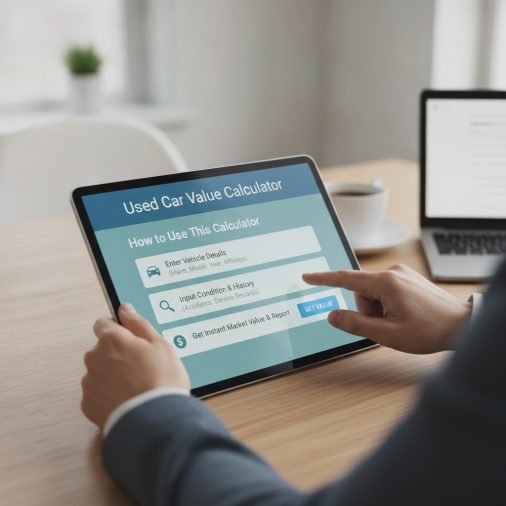
Follow these steps to get your used car value estimate:
- Enter the Original MSRP — Find the sticker price from the window label, manufacturer website, or a vehicle history report for your specific year, make, model, and trim.
- Enter the Vehicle Age — Count the number of full years since the model year. A 2019 model used in 2024 is 5 years old.
- Enter Current Mileage — Use the odometer reading. Round to the nearest thousand for a clean estimate.
- Select Vehicle Condition — Be honest. Overestimating condition is the most common mistake sellers make.
- Select Trim Level — Choose the closest match to your vehicle’s factory configuration.
- Select Regional Market Demand — Consider whether your vehicle type is in high demand locally (e.g., trucks in rural areas, hybrids in urban markets).
- Select Accident History — Use your vehicle history report (Carfax or AutoCheck) to confirm title status and accident records.
- Select Number of Previous Owners — Fewer owners generally signals better care history.
- Review all five results — Use the private party value as your anchor, trade-in as your floor when dealing with dealers, and dealer retail as context for lot pricing.
Understanding the Calculator Inputs
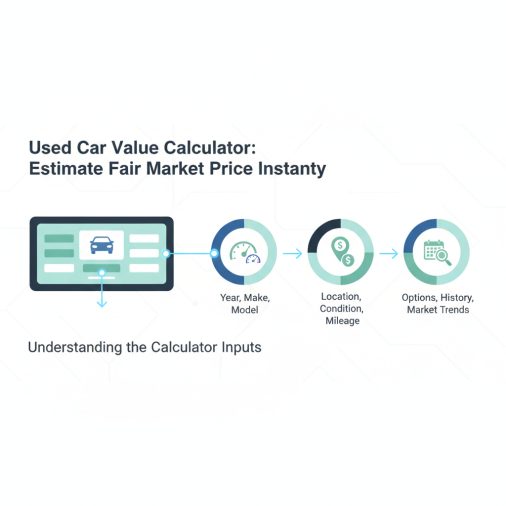
Original MSRP (USD): The Manufacturer’s Suggested Retail Price is the factory sticker price when the vehicle was new. This is the anchor for all depreciation calculations. You can find it on the original window sticker, the manufacturer’s archived configurator, or a vehicle history report. Do not use the price you paid — use the full MSRP including destination charges. For vehicles with significant factory options, use the as-configured MSRP if available.
Vehicle Age (Years): Count the number of full years since the model year. For example, a 2019 model evaluated in 2024 is 5 years old. Note that model years are often released a year early — a 2020 model sold in late 2019 would still be counted from 2019 for depreciation purposes since it has been on the road that long.
Current Mileage: Read the odometer directly. The calculator compares your actual mileage to an assumed average of 12,000 miles per year. Vehicles significantly below average mileage receive a value boost; those well above average receive a deduction. Round to the nearest thousand for a clean estimate.
Vehicle Condition: This is the most subjective input and the one most commonly misjudged. Excellent means the vehicle looks and drives like new with no visible wear, scratches, or mechanical issues — a rare standard most used cars do not meet. Good means minor cosmetic wear but fully functional with no warning lights or mechanical concerns. Fair means visible wear, minor dents or scratches, and possibly minor mechanical issues. Poor means significant body damage, mechanical problems, or a vehicle that needs substantial repair before it is roadworthy.
Trim Level: Higher trims include more factory features such as leather seats, advanced safety systems, larger engines, or premium audio, all of which help retain value. Choose the trim that most closely matches your vehicle’s factory configuration. If you are unsure, check the original window sticker or look up your VIN on the manufacturer’s website.
Regional Market Demand: Supply and demand vary significantly by geography. Pickup trucks command premiums in rural southern and western markets. Fuel-efficient hybrids and EVs often fetch more in urban coastal markets. If your vehicle type is scarce locally or in high demand, select High Demand. If the market is flooded with similar vehicles, select Low Demand.
Accident History: Use a vehicle history report from Carfax or AutoCheck to verify this accurately. Even a minor reported accident can reduce buyer confidence and resale value. A salvage or rebuilt title carries the steepest discount because many lenders will not finance these vehicles and some insurers will not provide full coverage.
Number of Previous Owners: Fewer owners generally suggests more consistent care and maintenance. A one-owner vehicle with complete service records is the gold standard. Each additional owner introduces uncertainty about how the vehicle was treated, which buyers price into their offers.
Understanding Your Results
Base Depreciated Value: This is the raw age-adjusted value of the vehicle before any condition, mileage, or market factors are applied. It represents what a typical vehicle of this age and original price would be worth if it were in average condition with average mileage. Use this as your mathematical starting point, not your final number.
Mileage Adjustment: This figure shows how much your vehicle’s mileage adds or subtracts from the base value. A negative mileage adjustment means your car has fewer miles than average for its age, which increases value — the calculator subtracts a negative number, effectively adding to the price. A positive mileage adjustment means above-average miles, which reduces value. This result is displayed as a raw dollar amount so you can see the isolated impact of mileage on your estimate.
Estimated Private Party Value: This is the core output — the price a private seller could reasonably ask or a private buyer could reasonably offer. It incorporates all inputs: depreciated base value, mileage delta, condition, trim, regional demand, accident history, and ownership count. Use this figure as your primary negotiating anchor in a private sale transaction.
Estimated Trade-In Value: This is approximately what a dealership might offer you if you trade the vehicle in. It is lower than private party value because dealers must account for reconditioning costs, lot overhead, and their own profit margin when they resell the vehicle. If a dealer offers you significantly less than this estimate, you have room to negotiate or consider selling privately instead.
Estimated Dealer Retail Price: This approximates what a dealership would list the vehicle for on their lot after reconditioning. If you are shopping at a dealer and the asking price is well above this estimate, you have a data-backed reason to negotiate down. If it is at or below this estimate, the pricing may already be competitive.
Suggested Negotiation Range: This ±5% buffer around the private party value gives you a practical floor and ceiling for negotiation. Your opening offer as a buyer might be the private party value minus this range; your walk-away price as a seller might be the private party value minus this range. As a buyer at a dealership, use the dealer retail estimate minus this range as your target.
Calculation Formulas Explained
Base Depreciated Value: msrp * pow(0.82, vehicle_age) — This applies compound annual depreciation at a rate of 18% per year (retaining 82% of value each year). The formula uses exponential decay, which mirrors how real depreciation works: the largest dollar drops happen in the first few years, and the rate of loss slows as the vehicle ages. An 18% annual rate is a widely cited industry average for mainstream consumer vehicles.
Mileage Adjustment: (mileage – (vehicle_age * 12000)) * 0.06 — The calculator assumes 12,000 miles per year as the national average. The difference between actual mileage and expected mileage is multiplied by $0.06 per mile. If a 5-year-old car has 80,000 miles instead of the expected 60,000, the excess 20,000 miles reduces value by $1,200. If it has only 40,000 miles, the 20,000-mile deficit adds $1,200 to value. The $0.06 per mile figure is a simplified approximation; actual per-mile value varies by vehicle segment.
Estimated Private Party Value: (Base Depreciated Value – Mileage Adjustment) * condition * trim_level * regional_demand * accident_history * owners — The mileage-adjusted base value is multiplied by five independent factors, each expressed as a decimal multiplier. Multipliers above 1.0 increase value; multipliers below 1.0 decrease it. Because these factors are multiplied together rather than added, their combined effect is proportional — a poor condition rating on an expensive car produces a larger dollar reduction than the same rating on a cheap car.
Estimated Trade-In Value: Private Party Value * 0.82 — Applies an 18% reduction to reflect the typical dealer discount for reconditioning, overhead, and resale margin. This is consistent with industry observations that trade-in offers run 15–20% below private party value on average.
Estimated Dealer Retail Price: Private Party Value * 1.12 — Applies a 12% markup to approximate the dealer’s listed retail price, reflecting lot costs, certification, and profit margin. Actual markups vary by dealer, vehicle desirability, and inventory levels.
Suggested Negotiation Range: Private Party Value * 0.05 — A 5% buffer is a practical and widely accepted starting point for used car negotiation. It is large enough to give both parties room to move without being so large that it signals an unrealistic opening position.
Worked Example
Example: 2019 Honda CR-V EX-L, 5 Years Old, 72,000 Miles
Suppose you are evaluating a 2019 Honda CR-V EX-L with an original MSRP of $32,000. The vehicle is 5 years old, has 72,000 miles on the odometer, is in Good condition, has a Premium trim level (EX-L), is in a market with Average demand, has a clean title with no accidents, and has had 2 previous owners.
Step 1 — Base Depreciated Value: $32,000 × 0.82^5 = $32,000 × 0.3707 = $11,862
Step 2 — Mileage Adjustment: (72,000 − (5 × 12,000)) × $0.06 = (72,000 − 60,000) × $0.06 = 12,000 × $0.06 = $720 (above average, so this reduces value)
Step 3 — Adjusted Base: $11,862 − $720 = $11,142
Step 4 — Apply Multipliers: $11,142 × 1.0 (Good) × 1.08 (Premium) × 1.0 (Average demand) × 1.0 (Clean title) × 0.97 (2 owners) = $11,142 × 1.08 × 0.97 = $11,142 × 1.0476 = $11,672
Step 5 — Results Summary:
- Estimated Private Party Value: $11,672
- Estimated Trade-In Value: $11,672 × 0.82 = $9,571
- Estimated Dealer Retail Price: $11,672 × 1.12 = $13,073
- Suggested Negotiation Range: $11,672 × 0.05 = ±$584
In this scenario, a reasonable private sale asking price would be around $11,672, a fair trade-in counter-offer floor would be approximately $9,571, and you would expect to see this vehicle listed on a dealer lot for roughly $13,000–$13,500. If a dealer offers you $8,500 on trade, you have data to push back toward $9,500.
How to Interpret the Results
The Estimated Private Party Value is your most useful anchor. It represents a fair transaction price between two informed individuals with no institutional overhead involved. If you are selling privately, list slightly above this number to leave room for negotiation. If you are buying privately, use this as your target and the negotiation range as your buffer.
The Estimated Trade-In Value is a realistic floor for dealer negotiations. Dealers will rarely offer more than private party value, and most offers will fall in the range between trade-in and private party value. If a dealer’s offer is below the trade-in estimate, consider selling privately or using competing dealer offers as leverage.
The Estimated Dealer Retail Price gives you context when shopping on a dealer lot. A vehicle priced well above this estimate may have premium features, low mileage, or certification costs built in — or it may simply be overpriced. A vehicle priced at or below this estimate is likely competitively positioned.
The Suggested Negotiation Range is your practical tool for setting a walk-away price before you enter any negotiation. Decide in advance the maximum you will pay (as a buyer) or the minimum you will accept (as a seller), and commit to it. Emotional decisions made in the moment of negotiation consistently cost buyers and sellers money.
Remember that this calculator produces estimates based on general market averages. Specific makes and models — particularly luxury brands, trucks, and EVs — may depreciate very differently. Always verify your estimate against at least two official pricing sources before making a financial commitment.
Common Mistakes to Avoid
- Overestimating condition: Most used cars are in Good condition, not Excellent. Excellent is a rare standard that requires near-perfect paint, interior, and mechanical condition. Sellers who rate their car Excellent when it is Good will be disappointed by real-world offers.
- Using the purchase price instead of MSRP: The calculator requires the original factory MSRP, not what you paid or what the car is listed for today. Using a discounted purchase price as the base will underestimate the vehicle’s depreciated value.
- Ignoring accident history: Many sellers forget about minor fender-benders that were reported to insurance. Buyers who pull a vehicle history report will find these records, and the value impact is real regardless of how well the repair was done.
- Assuming regional demand is always average: If you are selling a diesel pickup in a rural farming community or a compact hybrid in a dense urban market, demand is likely above average. Selecting the wrong demand tier can shift your estimate by several hundred dollars.
- Treating the estimate as a final price: This calculator is a planning tool, not an appraisal. Real-world prices are influenced by factors this model cannot capture, including specific option packages, color popularity, current inventory levels, and local economic conditions. Always cross-reference with official pricing guides.
- Forgetting to account for needed repairs: If the vehicle needs new tires, brakes, or other maintenance, deduct those costs from your estimate before negotiating. A buyer will factor in repair costs; a seller should too.
Limitations and Important Notes
This calculator is an independent estimating tool and is not affiliated with, endorsed by, or derived from Kelley Blue Book, Edmunds, NADA Guides, or any other official pricing service. Results are mathematical estimates based on generalized depreciation curves and industry-average adjustment factors.
The 18% annual depreciation rate is a broad average. Luxury vehicles, trucks, and certain SUVs often depreciate more slowly; economy cars and some domestic models may depreciate faster. Electric vehicles have shown highly variable depreciation patterns that this model does not specifically capture.
The $0.06 per-mile mileage adjustment is a simplified approximation. Actual per-mile value impact varies significantly by vehicle segment, age, and market conditions. The 12,000 miles-per-year average may not reflect your region or driver profile.
This calculator does not account for specific factory option packages, color desirability, regional fuel price effects on truck or SUV demand, current inventory shortages or surpluses, certified pre-owned program premiums, or the specific reputation of individual makes and models for reliability.
Salvage and rebuilt title vehicles may carry additional legal, insurance, and financing restrictions not captured by the value multiplier alone. Consult a licensed appraiser or attorney before transacting on a salvage title vehicle.
Results are estimates only and should not be used as the sole basis for any financial, purchasing, or lending decision. Always obtain a professional appraisal and consult multiple pricing sources before finalizing any used vehicle transaction.
Frequently Asked Questions
What is the difference between private party value and trade-in value?
Private party value is the estimated price two private individuals would agree on in a direct sale — no dealership overhead, reconditioning costs, or profit margin involved. Trade-in value is what a dealership will typically offer you for your vehicle when you are purchasing another car from them. Dealers must account for the cost of inspecting, reconditioning, and reselling your vehicle, plus their own profit margin, which is why trade-in offers typically run 15–20% below private party value. If maximizing your return is the priority, selling privately almost always yields more money than trading in, though it requires more time and effort.
How accurate is an online used car value calculator?
Online used car value calculators — including this one — are useful planning tools but are not appraisals. Their accuracy depends on how well the inputs reflect the actual vehicle and how closely the vehicle matches the general market averages the model is built on. Mainstream consumer vehicles in average condition with typical mileage will produce estimates closest to real-world prices. Unusual vehicles, collector cars, heavily modified vehicles, or cars in markets with extreme supply or demand conditions may produce estimates that diverge significantly from actual transaction prices. For the most accurate valuation, cross-reference this estimate with Kelley Blue Book, Edmunds, and NADA, and consider a professional appraisal for high-value transactions.
Does accident history always lower a car's value?
In practice, yes — any reported accident reduces a vehicle’s market value, even if the repair was done perfectly. This is because buyers cannot independently verify repair quality without a professional inspection, and the uncertainty itself is priced into their offers. The degree of reduction depends on the severity of the accident, the quality of the repair, and whether the title was affected. A minor cosmetic repair with a clean title might reduce value by 10–15%. A major structural repair can reduce value by 25% or more. A salvage or rebuilt title carries the steepest discount because many lenders will not finance these vehicles and some insurers will not provide comprehensive coverage, which significantly limits the buyer pool.
What counts as excellent condition for a used car?
Excellent condition is a high bar that most used vehicles do not meet. To qualify as excellent, a vehicle should have no visible scratches, dents, or paint chips; an interior free of stains, tears, or significant wear; all mechanical systems functioning perfectly with no warning lights; tires with substantial tread remaining; and a complete, documented service history. Vehicles that have been garage-kept, driven conservatively, and meticulously maintained may qualify. If you are unsure whether your vehicle meets this standard, default to Good — overestimating condition is the most common mistake sellers make and leads to disappointment when real-world offers come in lower than expected.
How does mileage affect used car value compared to age?
Both age and mileage matter, but they affect value through different mechanisms. Age drives depreciation through time-based factors: technology becomes outdated, warranties expire, and the vehicle simply has more years of potential wear regardless of how it was used. Mileage reflects actual mechanical wear — engine cycles, transmission shifts, brake applications, and suspension stress. A low-mileage older vehicle can command a significant premium because the mechanical components have experienced less wear. Conversely, a newer vehicle with very high mileage may be worth less than its age alone would suggest. This calculator treats age as the primary depreciation driver and mileage as a secondary adjustment, which reflects how most pricing guides approach the relationship.
Is a salvage title car ever worth buying?
A salvage title vehicle can represent a significant discount — sometimes 40–50% below clean-title market value — which makes them attractive to mechanically knowledgeable buyers who can assess repair quality independently. However, the risks are substantial. Many lenders will not finance salvage title vehicles, requiring cash purchase. Some insurers will not provide comprehensive or collision coverage, or will only insure at a reduced value. Reselling a salvage title vehicle is difficult because the same concerns that make you hesitant will make future buyers hesitant. If you are considering a salvage title vehicle, a thorough pre-purchase inspection by an independent mechanic is essential, and you should consult your insurer before purchase to confirm coverage availability.
What is a reasonable amount to negotiate off a used car price?
A 5% negotiation buffer around the private party value is a practical and widely accepted starting point for used car negotiation. In a private sale, opening 5–8% below the asking price gives both parties room to meet in the middle without insulting the seller. At a dealership, the gap between trade-in value and dealer retail price represents the dealer’s margin, and negotiating toward the middle of that range is realistic. Vehicles that have been sitting on a lot for more than 60 days, vehicles with known issues, or markets with high inventory give buyers more leverage. Hot models in low-inventory markets may have little or no negotiating room. Always research the specific vehicle’s market before deciding how aggressively to negotiate.
Should I use multiple pricing sources when valuing a used car?
Yes — using multiple pricing sources is strongly recommended before any used car transaction. Different services use different data sets, methodologies, and regional samples, which means their estimates can vary by hundreds or even thousands of dollars for the same vehicle. Kelley Blue Book, Edmunds, and NADA Guides are the three most widely cited sources in the United States, and comparing all three gives you a realistic range rather than a single number to anchor on. This independent calculator adds a transparent, formula-based perspective that shows you exactly how each factor affects the estimate. Treat the convergence zone across multiple sources as your most reliable price range, and be skeptical of any asking price that falls well outside that zone without a clear explanation.