Use this car journey cost calculator to instantly estimate how much your next road trip will cost. Enter your trip distance, vehicle fuel efficiency, current fuel price, and any tolls or extras to get a full cost breakdown in seconds. Whether you are planning a weekend getaway, a daily commute, or a long-distance drive, this tool helps you budget confidently by revealing your fuel spend, toll charges, and total journey cost before you even turn the key.
Car Journey Cost Calculator: Fuel, Tolls & Total Trip Cost
Estimate the complete cost of any car journey including fuel, tolls, parking, food, and vehicle wear with this easy-to-use road trip cost calculator.
How to Use This Calculator
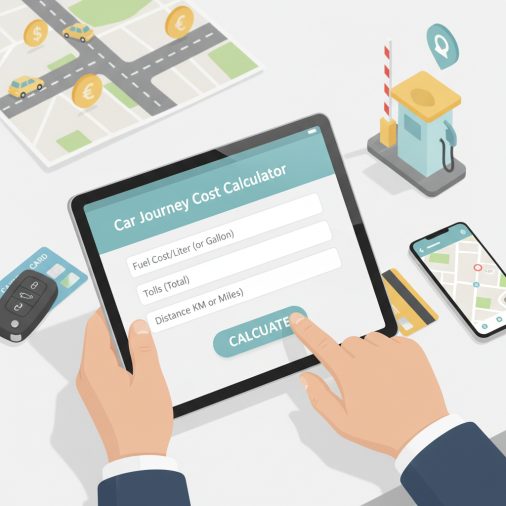
Follow these steps to get an accurate estimate of your car journey cost:
- Enter your trip distance and choose whether you are working in miles or kilometres.
- Enter your vehicle’s fuel efficiency in MPG (miles per gallon). If you know your efficiency in L/100km, use the conversion tip in the input guide below to convert it first.
- Enter the current fuel price per gallon at your local pump.
- Set the number of passengers including yourself so the calculator can split costs fairly.
- Add any toll charges you expect to pay along your route.
- Optionally add parking and food costs to capture the full trip budget.
- Select a vehicle wear category to include tyre, maintenance, and depreciation costs.
- Read your results: fuel cost, wear cost, total journey cost, cost per mile, and cost per person are all calculated instantly.
Understanding the Calculator Inputs
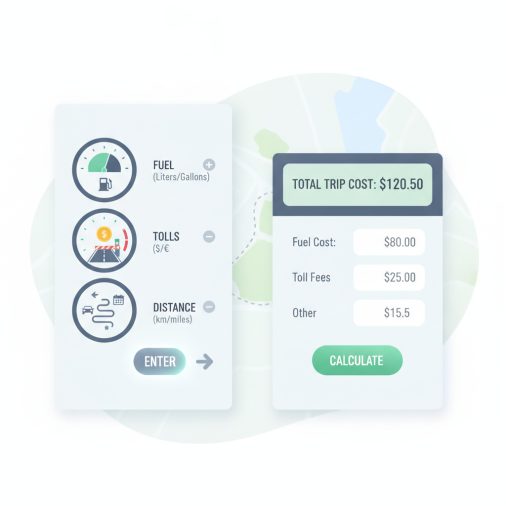
Trip Distance: Enter the one-way distance from your starting point to your destination. Use a mapping app such as Google Maps or Apple Maps to find an accurate figure. Remember that this calculator assumes a one-way trip, so if you are making a return journey, double the distance before entering it.
Distance Unit: Choose Miles if you are in the United States or the United Kingdom and your mapping app reports in miles. Choose Kilometres if you are in Canada, Australia, or Europe. The calculator automatically converts kilometres to miles internally so all results remain consistent.
Fuel Efficiency (MPG): Enter your vehicle’s fuel economy in miles per gallon. You can find this figure in your owner’s manual, on the manufacturer’s website, or on the fuel economy label. If you only know your efficiency in litres per 100 kilometres (L/100km), convert it using the formula: MPG = 235.21 divided by your L/100km figure. For example, 7 L/100km equals approximately 33.6 MPG.
Fuel Price per Gallon: Enter the current price you pay at the pump per US gallon. If your local price is displayed per litre, multiply by 3.785 to convert to per-gallon. UK drivers paying in pence per litre should multiply by 3.785 and then divide by the current GBP/USD exchange rate to get a dollar-equivalent, or simply use the same currency consistently throughout.
Number of Passengers (incl. driver): Use the slider to set the total number of people in the vehicle including yourself. This value is used only to calculate the cost-per-person split and does not affect fuel consumption in this calculator.
Total Toll Charges: Enter the total amount you expect to pay in road tolls, bridge fees, or tunnel charges for the entire journey. Check your route on a toll calculator website or your mapping app’s toll estimate feature for accuracy. Leave at zero if your route has no tolls.
Parking Cost: Include any parking fees you expect to pay at your destination or at stops along the way. This might include airport parking, city centre car parks, or event venue parking. Leave at zero if parking is free.
Food and Refreshments: Add an estimate for meals, snacks, and drinks you plan to purchase during the journey. This is entirely optional and based on your personal budget.
Vehicle Wear & Depreciation: Select the category that best matches your vehicle type. Low suits small economy cars with low running costs. Average suits typical mid-size sedans and hatchbacks. High suits larger SUVs, trucks, and performance vehicles. These rates are broad estimates informed by AAA and IRS standard mileage guidance categories. Select None if you want a fuel-only cost estimate.
Understanding Your Results
Distance in Miles: This is your entered distance converted to miles. If you entered kilometres, the calculator has multiplied by 0.621371 to convert. All other results are based on this figure, so verify it looks correct before reading the cost outputs.
Fuel Cost: This is the estimated amount you will spend on fuel for the journey. It is calculated by dividing your trip miles by your MPG to find gallons consumed, then multiplying by your fuel price per gallon. This is typically the largest single cost component for most journeys.
Wear & Depreciation Cost: This figure represents the estimated mechanical wear, tyre degradation, and vehicle depreciation attributable to the journey. It is calculated by multiplying your trip miles by the per-mile rate you selected. Many drivers overlook this cost, but it is real and accumulates significantly over time.
Total Journey Cost: This is the sum of all cost components: fuel, tolls, parking, food, and vehicle wear. It represents your complete estimated expenditure for the trip and is the most useful figure for overall budget planning.
Cost Per Mile: The total journey cost divided by the number of miles travelled. This metric is useful for comparing the efficiency of different routes, evaluating whether a longer but faster motorway route is worth it, or calculating reimbursement claims for business travel.
Cost Per Person: The total journey cost divided equally among all passengers. This is the fairest way to split road trip expenses in a carpool. If passengers are contributing to fuel only and not to tolls or parking, you may want to note those separately.
Calculation Formulas Explained
The calculator uses the following core formulas, all applied consistently in miles regardless of your input unit:
Distance in Miles: distance × unit_choice. When you select Miles, unit_choice equals 1 so the distance is unchanged. When you select Kilometres, unit_choice equals 0.621371, converting km to miles.
Fuel Consumed (gallons): distance_in_miles / fuel_efficiency. Dividing miles by miles-per-gallon gives the number of gallons needed. The formula uses max(fuel_efficiency, 0.001) to prevent division by zero if a zero value is somehow entered.
Fuel Cost: gallons_consumed × fuel_price. Multiplying gallons by the price per gallon gives the total fuel spend in your chosen currency.
Wear & Depreciation Cost: distance_in_miles × wear_rate. The selected per-mile rate is multiplied by total miles to estimate cumulative mechanical and depreciation costs.
Total Journey Cost: fuel_cost + toll_cost + parking_cost + food_cost + wear_cost. A straightforward sum of all five cost components.
Cost Per Mile: total_journey_cost / distance_in_miles. Uses max(distance_in_miles, 0.001) to prevent division by zero.
Cost Per Person: total_journey_cost / passengers. Uses max(passengers, 1) to prevent division by zero.
Worked Example
Scenario: A family of three drives 250 miles from Chicago to Milwaukee and back (500 miles total return). Their SUV gets 28 MPG. Fuel costs $3.80 per gallon. They expect $12 in tolls, $15 in parking, and $45 in food. They select the High wear rate ($0.12/mi) for their SUV.
- Enter distance: 500 miles (return trip doubled), unit set to Miles.
- Distance in miles: 500 × 1 = 500 mi
- Fuel consumed: 500 / 28 = 17.857 gallons
- Fuel cost: 17.857 × $3.80 = $67.86
- Wear & depreciation: 500 × $0.12 = $60.00
- Total journey cost: $67.86 + $12.00 + $15.00 + $45.00 + $60.00 = $199.86
- Cost per mile: $199.86 / 500 = $0.400/mi
- Cost per person: $199.86 / 3 = $66.62/person
This example shows how vehicle wear and depreciation ($60) nearly matches the fuel cost ($67.86), demonstrating why fuel-only estimates significantly understate the true cost of driving an SUV.
How to Interpret the Results
Once you have your results, consider the following benchmarks to put them in context:
Fuel cost alone is what most people think of as their journey cost, but it typically represents only 50–70% of the true total when wear, tolls, and extras are included. If your fuel cost seems high, check whether your MPG figure is realistic for your driving conditions — highway driving typically yields better efficiency than city driving.
Cost per mile is a powerful comparison metric. The IRS standard mileage rate for 2024 is 67 cents per mile for business travel, which is designed to cover fuel, wear, insurance, and depreciation. If your calculated cost per mile is significantly above this, you may be driving a less efficient vehicle or including high discretionary costs. If it is well below, you may be underestimating wear or using an optimistic MPG figure.
Cost per person helps evaluate whether driving is competitive with other transport options. If your cost per person for a 200-mile trip is $35, compare that against train or bus fares for the same route. Carpooling with even one additional passenger can cut your personal share dramatically, making driving the most economical option for groups. If you are travelling with children, ensuring you have appropriate safety equipment — such as a low-cost convertible car seat — is an important part of trip planning that adds minimal cost.
Total journey cost should be compared against your travel budget before departure. If the total exceeds your budget, consider reducing discretionary costs like food, finding free parking, or choosing a more fuel-efficient vehicle.
Common Mistakes to Avoid
Using city MPG instead of highway MPG: Most road trips are predominantly highway driving, which typically yields 15–30% better fuel economy than city driving. Using your city MPG will overestimate fuel costs. Use your combined or highway MPG for long trips.
Forgetting the return journey: This calculator estimates a one-way trip. If you are making a round trip, double your distance before entering it. This is the single most common error users make.
Ignoring vehicle wear: Many drivers calculate only fuel costs and are surprised by the true cost of ownership. Tyre wear, oil changes, brake wear, and depreciation are real costs that accumulate with every mile driven. Selecting a wear rate gives a more honest picture of what driving actually costs.
Using an outdated fuel price: Fuel prices fluctuate daily. Always check the current price at your intended fuel stops rather than using a figure from memory. A difference of $0.30 per gallon on a 400-mile trip in a 30 MPG car adds up to $4 — small but worth noting for tight budgets.
Underestimating tolls: Toll costs on major routes can be surprisingly high, especially on turnpikes and bridges. Use a dedicated toll calculator for your specific route rather than guessing. Some routes charge different rates for different vehicle classes or times of day.
Not accounting for traffic and detours: Heavy traffic reduces fuel efficiency significantly. If your route includes known congestion, consider adding 10–15% to your fuel cost estimate to account for stop-and-go driving.
Limitations and Important Notes
This calculator provides planning estimates only and is subject to the following assumptions and limitations:
- Fuel efficiency is treated as a constant MPG figure for the entire journey. Real-world efficiency varies with speed, load, road gradient, weather, tyre pressure, and driving style.
- The L/100km efficiency unit is noted for user awareness, but the formula uses MPG directly. Users with L/100km figures must convert to MPG before entering (divide 235.21 by your L/100km value).
- Fuel price is entered as price per US gallon. Users in other countries should convert their local price to a per-gallon equivalent in a consistent currency.
- Toll costs must be estimated by the user. No live toll data or route API is used.
- Wear and depreciation rates are broad category estimates informed by AAA and IRS guidance and are not specific to any individual vehicle make, model, age, or condition.
- All monetary inputs and outputs are in the same currency as entered. No currency conversion is performed.
- The calculator assumes a one-way trip. Double the distance for return journeys.
- Food and parking costs are entirely user-estimated and not derived from any external pricing data.
- This tool is intended for budgeting and planning purposes only. It does not constitute financial, tax, or professional transport advice.
Frequently Asked Questions
How do I calculate the fuel cost of a car journey?
To calculate fuel cost, divide your trip distance in miles by your vehicle’s fuel efficiency in miles per gallon (MPG) to find the number of gallons you will use. Then multiply that figure by the current price per gallon. For example, a 200-mile trip in a car that gets 32 MPG uses 6.25 gallons. At $3.60 per gallon, the fuel cost is $22.50. This calculator performs that calculation automatically once you enter your distance, MPG, and fuel price.
What is the average cost per mile to drive a car in the US?
According to AAA’s annual Your Driving Costs study, the average cost per mile to own and operate a new vehicle in the United States ranges from approximately $0.50 to $0.80 per mile when all costs are included — fuel, maintenance, tyres, depreciation, insurance, and finance charges. For a simple fuel-plus-wear estimate on a road trip, most drivers fall in the $0.25 to $0.45 per mile range depending on vehicle type and fuel price. The IRS standard mileage rate for 2024 is 67 cents per mile for business use, which is a commonly used benchmark.
How much does a 100-mile road trip cost in fuel?
The fuel cost of a 100-mile trip depends entirely on your vehicle’s MPG and the local fuel price. At 30 MPG and $3.50 per gallon, a 100-mile trip uses approximately 3.33 gallons and costs around $11.67 in fuel. At 20 MPG and $4.00 per gallon, the same distance costs $20.00. Use this calculator to enter your specific figures for an accurate personalised estimate rather than relying on averages.
How do I split road trip costs fairly among passengers?
The fairest approach is to divide the total journey cost — including fuel, tolls, parking, and any shared food — equally among all passengers including the driver. This calculator’s Cost Per Person result does exactly that. If some passengers are only contributing to fuel and not to parking or food, you can calculate those separately. For longer trips where passengers join or leave at different points, consider splitting only the fuel cost proportionally by distance travelled and handling other costs separately.
Does this calculator work for electric vehicle journey costs?
This calculator is designed for petrol and diesel vehicles and uses MPG as its efficiency metric. It does not directly support electric vehicle (EV) cost calculations, which are based on kilowatt-hours per mile (kWh/mi) and electricity price per kWh rather than fuel price per gallon. To estimate EV journey costs, you would need a dedicated EV range and cost calculator. However, you can use this tool as a comparison baseline to see how much a petrol vehicle would cost for the same journey versus your EV’s electricity cost.
What is vehicle wear and depreciation and why should I include it?
Vehicle wear and depreciation refers to the real costs that accumulate with every mile you drive: tyre wear, engine oil consumption, brake pad degradation, and the gradual reduction in your vehicle’s resale value. These costs are invisible at the pump but are very real over time. For example, at $0.08 per mile, a 500-mile road trip adds $40 in wear costs on top of your fuel bill. Including wear in your journey cost gives a more honest picture of what driving truly costs and is especially important for business mileage reimbursement calculations.
How do I convert L/100km to MPG for use in this calculator?
To convert litres per 100 kilometres (L/100km) to miles per gallon (MPG), divide 235.21 by your L/100km figure. For example, if your car uses 8 L/100km, the MPG equivalent is 235.21 / 8 = 29.4 MPG. Enter this converted figure into the Fuel Efficiency field. Note that this conversion assumes US gallons; UK MPG uses imperial gallons and the conversion factor is 282.48 instead of 235.21. For most planning purposes, the US gallon conversion is sufficient.
How accurate is this car journey cost calculator?
The calculator is mathematically accurate given the inputs you provide, but its real-world accuracy depends on how realistic your inputs are. Fuel efficiency in particular varies significantly with speed, load, air conditioning use, road gradient, and driving style — a figure that differs by even 5 MPG can change your fuel cost estimate by 10–20% on a long trip. Toll costs depend on your exact route and vehicle class. For the most accurate results, use your vehicle’s real-world average MPG from recent fill-ups, check current fuel prices at your planned stops, and verify toll costs using a route-specific toll calculator.