Plenty of car audio setups have an amplifier that only offers speaker-level outputs — and many subwoofers are designed to work with exactly that kind of signal. The question is whether your specific sub and amp are compatible, and how to wire them correctly.
Yes, you can connect a subwoofer to a car amplifier using speaker-level outputs. Most passive subwoofers accept speaker-level (high-level) connections directly. If your amp only has speaker outputs and no RCA preamp outputs, you run speaker wire from the amp’s output terminals to the subwoofer’s input terminals, matching polarity carefully. Powered subwoofers with built-in amps typically require RCA or high-level adapter inputs instead.
Speaker-Level vs. RCA Outputs: What Your Amp Is Actually Sending
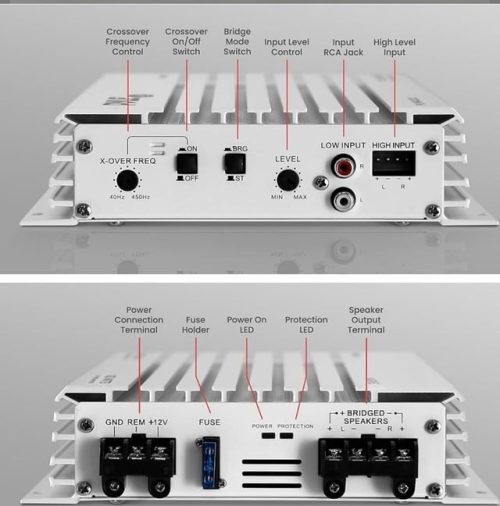
Car amplifiers typically offer two types of output connections:
- Speaker-level outputs — carry an amplified audio signal, measured in watts, sent through binding posts or push-pin terminals
- RCA preamp outputs — carry a low-level line signal, measured in volts, designed for connecting to a second amplifier or signal processor
Speaker-level outputs are what actually power speakers. When your amp drives a door speaker or tweeter, it’s sending amplified signal through those terminals. A passive subwoofer — one with no built-in amplifier — simply receives that amplified signal and converts it to bass movement, just like any other speaker.
Many entry-level and mid-range car amps are designed as full-range or component amplifiers with speaker outputs only. No RCA outputs at all. That’s a common configuration, and it doesn’t prevent you from adding a subwoofer.
Passive Subwoofers vs. Powered Subwoofers: Which Works Here
The distinction matters a lot for wiring.
Passive subwoofers have no internal amplifier. They accept amplified speaker-level signal directly from an amp’s speaker output terminals, exactly the same as a door speaker would. These are the easiest to connect to an amp with speaker outputs.
Powered (active) subwoofers have a built-in amplifier. They need a low-level input signal — typically RCA — or a dedicated high-level input adapter. If your main amp has no RCA outputs, connecting a powered sub requires either a line output converter (LOC) or using the powered sub’s built-in high-level input if it has one.
Many powered underseat subwoofers like the Rockford Fosgate PS-8 include high-level input wiring that connects directly to your amp’s speaker outputs, which solves the problem without additional hardware.
Impedance and Power: Making Sure the Load Is Safe
Before wiring a subwoofer to an amp’s speaker output, check two numbers: the amp’s minimum rated impedance and the subwoofer’s impedance.
Most car amplifiers are stable down to 4 ohms per channel, with some rated for 2 ohms. Subwoofers typically come in 2-ohm, 4-ohm, or dual-voice-coil configurations.
If you connect a 2-ohm subwoofer to an amp rated only for 4-ohm loads, you risk overheating and potentially damaging the amplifier. A 4-ohm sub on a 4-ohm stable amp is a safe match. Dual voice coil (DVC) subwoofers give you wiring flexibility — wiring both coils in series doubles the impedance, while wiring in parallel halves it.
Always check the amp’s owner manual or manufacturer spec sheet before finalizing the connection. Getting the impedance wrong is one of the most commonly overlooked installation mistakes.
Step-by-Step: Wiring a Passive Sub to a Car Amp with Speaker Outputs
This procedure applies when you have a passive subwoofer and a car amplifier with speaker-level output terminals.
- Disconnect the vehicle’s negative battery terminal before starting any wiring work. This prevents shorts and protects the amplifier.
- Identify an available output channel on the amp. Many 4-channel amps can bridge channels 3 and 4 into a single mono output, which significantly increases the power available to the subwoofer.
- Check bridging compatibility. If bridging, verify the amp supports bridged operation at the resulting load. Bridging a 4-ohm stable amp into a 4-ohm sub is usually fine; bridging into a 2-ohm sub on a 4-ohm stable amp is not.
- Cut speaker wire to the appropriate length — 16 AWG is minimum for subwoofer runs under 10 feet, 14 AWG or thicker is better for longer runs or higher-power applications.
- Connect the positive wire from the amp’s positive output terminal to the subwoofer’s positive input terminal. Repeat for the negative/ground terminal.
- Double-check polarity. Reversed polarity between the sub and the rest of the speakers causes phase cancellation, which dramatically reduces bass output. Many installs lose half their bass this way.
- Set the amp’s low-pass crossover to filter out frequencies above roughly 80–120 Hz, depending on your setup. This ensures the subwoofer only reproduces bass frequencies.
- Reconnect the battery and test at low volume first, listening for distortion, noise, or any unusual smell from the amp.
When You Need a Line Output Converter Instead
If your amplifier only has RCA preamp inputs — no speaker input terminals — and you want to run it from a source that only provides speaker-level signal (like a factory head unit), you’ll need a line output converter (LOC).
An LOC takes the amplified speaker signal and converts it down to a low-level RCA signal. Devices like the PAC LP7-2 AudioDirect are commonly used for this purpose in factory integration setups.
This scenario is different from using speaker outputs on an amp. But it’s worth understanding the difference so you’re solving the right problem for your specific wiring situation.
Crossover Settings That Actually Make a Difference
Getting the crossover right separates a clean bass install from a muddy, boomy mess. Here’s what to set:
| Setting | Recommended Starting Point | Notes |
|---|---|---|
| Low-pass filter (LPF) | 80 Hz | Blocks highs from reaching the sub |
| Subsonic filter | 25–35 Hz | Protects ported box subs from over-excursion |
| Gain | Match to head unit output | Never max the gain; it increases distortion |
| Bass boost | 0 dB | Only add if needed, and minimally |
Many amplifiers include a built-in low-pass filter. If yours doesn’t, an external crossover or an equalizer in line can accomplish the same thing.
Common Wiring Mistakes to Avoid
Reversed polarity is probably the most frequent error. When the sub moves out of phase with the front speakers, bass response collapses noticeably.
Undersized wire causes voltage drop and limits power delivery. For subwoofer applications drawing 200+ watts, 14 AWG or 12 AWG speaker wire is typically the better choice.
Improper gain setting is another recurring issue. The gain knob on an amp isn’t a volume control — it’s an input sensitivity adjustment. Setting it too high clips the signal and generates distortion that can damage both the amp and the sub over time.
Skipping the low-pass filter sends full-range signal to the sub, which wastes amplifier power and often makes the bass sound thin and unfocused.
Checking Compatibility Before You Buy or Wire
If you’re planning this build from scratch, match these specs before purchasing:
- Subwoofer impedance (ohms) must match amp’s minimum stable load
- Subwoofer RMS power handling should be close to the amp’s RMS output at that impedance
- Enclosure type (sealed vs. ported) affects which subsonic filter settings are safe
- Available mounting space in the vehicle determines whether a traditional box or an under-seat powered sub makes more sense
Many installs fail not because of bad equipment, but because mismatched specs caused either underpowering (weak bass) or overpowering (blown sub).
FAQ
Can I connect a subwoofer directly to the speaker terminals on a regular car amplifier?
Yes, a passive subwoofer connects directly to the speaker-level output terminals on any car amplifier. Use the correct wire gauge, match impedance, and set the low-pass crossover appropriately. This is the standard wiring method for passive subs and works with any amp that has speaker output binding posts or push-pin terminals.
What happens if the subwoofer impedance is too low for the amplifier?
Running a sub with lower impedance than the amp’s minimum rating causes the amp to draw excessive current, generate too much heat, and potentially trigger thermal protection or fail entirely. Always verify the amp’s minimum stable impedance before wiring. If you’re using a dual voice coil sub, wire the coils in series to raise the impedance if needed.
Do I need an RCA cable to connect a sub to an amp with only speaker outputs?
No. If the amp only has speaker-level outputs and the subwoofer is a passive unit, you only need speaker wire — no RCA cables required. RCA connections are used between a head unit or preamp and an amplifier’s input, not between an amp’s output and a passive speaker or subwoofer.
Can I bridge my 4-channel amp to run a subwoofer from the speaker outputs?
Yes, most 4-channel amplifiers allow you to bridge channels 3 and 4 into a single mono output for a subwoofer. This typically doubles the power output to that channel. Check your amp’s manual to confirm it supports bridged mode and verify the minimum impedance when bridged — many amps that are 2-ohm stable per channel are only 4-ohm stable when bridged.
Why does my subwoofer sound weak even though it’s connected to the amp?
Weak bass after connecting a sub usually points to reversed polarity causing phase cancellation, gain set too low, no low-pass filter allowing full-range signal, or an impedance mismatch limiting power output. Check polarity first — it’s the most common culprit. Then verify gain settings and confirm the low-pass filter is active and set to 80–100 Hz.
Can a powered subwoofer be connected to an amp’s speaker outputs?
Some powered subwoofers include a high-level input that accepts speaker-level signal directly from an amp’s speaker outputs. If the powered sub only has RCA inputs, you’ll need a line output converter between the amp’s speaker outputs and the sub’s RCA inputs. Check the sub’s input specs before wiring to avoid damaging the built-in amplifier.
Is it safe to run both door speakers and a subwoofer from the same amplifier channel?
Generally no. Running a sub and a door speaker on the same amp channel creates an impedance load that can drop below the amp’s safe minimum. It also makes crossover filtering impractical since both speakers would receive the same signal. Use separate amp channels — bridge two channels for the sub, or use a dedicated mono amplifier for subwoofer duty.
Connecting a passive subwoofer to a car amp with speaker outputs is a straightforward process when impedance, polarity, wire gauge, and crossover settings are handled correctly. The most critical checks are matching the sub’s impedance to the amp’s minimum load rating and verifying polarity before powering up. Get those two things right, and the install will perform the way it’s supposed to.