Use this car loan calculator for Jamaica to instantly estimate your monthly repayment, total interest, and overall cost of financing your next vehicle. Simply enter the vehicle price, your down payment, the annual interest rate offered by your lender, and your preferred loan term. Results are displayed in Jamaican dollars (JMD) and reflect typical hire-purchase or personal loan structures common at Jamaican commercial banks and credit unions. The calculator also factors in a lender processing fee and your estimated monthly insurance premium so you can see the true all-in cost of vehicle ownership over the loan period. No sign-up required.
Car Loan Calculator Jamaica: Monthly Payment & Total Cost in JMD
Calculate your monthly car loan repayment, total interest paid, processing fee, and full ownership cost in Jamaican dollars using locally relevant interest rates and loan terms.
How to Use This Calculator
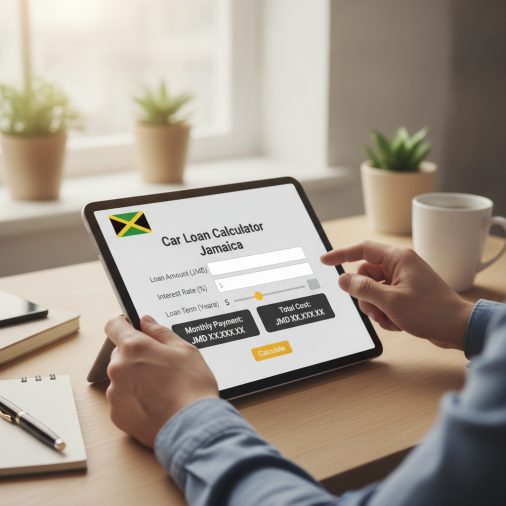
Follow these steps to get an accurate estimate of your car loan costs in Jamaica:
- Enter the Vehicle Price (JMD): Type the full purchase price of the car you intend to buy, including any dealer fees already quoted in the price.
- Enter Your Down Payment (JMD): Input the lump sum you plan to pay upfront. The calculator subtracts this from the vehicle price to determine your loan principal.
- Set the Annual Interest Rate: Use the slider to select the nominal annual interest rate your bank or credit union has quoted. Rates in Jamaica typically range from 12% to 30% per annum.
- Choose Your Loan Term: Select the repayment period from the dropdown, ranging from 12 to 84 months.
- Set the Processing Fee Percentage: Adjust the slider to match the arrangement or processing fee your lender charges as a percentage of the loan principal.
- Enter Monthly Insurance (JMD): Input your estimated monthly comprehensive motor insurance premium. This is required by most Jamaican lenders for financed vehicles.
- Read Your Results: The calculator instantly displays your loan principal, monthly payment, total amount repaid, total interest paid, processing fee, and total cost of ownership over the loan period.
Understanding the Calculator Inputs
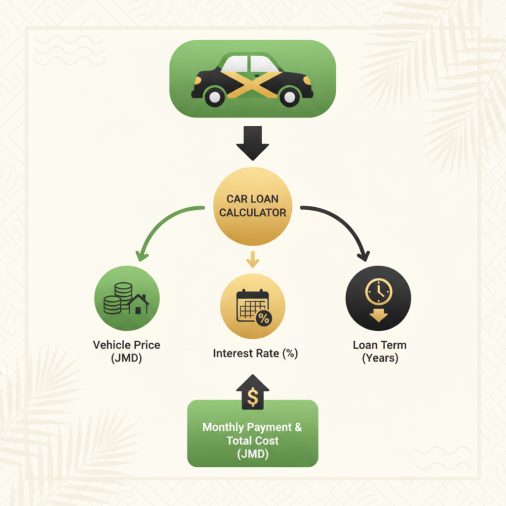
Vehicle Price (JMD): Enter the full agreed purchase price of the vehicle in Jamaican dollars. For a used car purchased from a dealer, this is typically the sticker price before any negotiation discount. For a new car, use the on-the-road price quoted by the dealership. Do not include stamp duty or transfer tax here, as those are separate government fees paid at the time of registration.
Down Payment (JMD): The down payment is the portion of the vehicle price you pay upfront from your own funds. In Jamaica, most lenders require a minimum down payment of 10% to 20% of the vehicle price, though putting down more reduces your loan principal and therefore your monthly payment and total interest. Enter zero if you are exploring 100% financing options, though these are less common in the Jamaican market.
Annual Interest Rate (%): Use the slider to set the nominal annual interest rate your lender has quoted. As of 2024, Jamaican commercial banks typically offer vehicle loan rates between 12% and 25% per annum, while some credit unions may offer slightly lower rates to members. The rate you receive depends on your credit history, income, the age of the vehicle, and the lender’s current policy. Always confirm whether the rate quoted is a nominal or effective annual rate.
Loan Term: Select the number of months over which you will repay the loan. Shorter terms (12–36 months) result in higher monthly payments but significantly less total interest. Longer terms (60–84 months) lower the monthly burden but increase the total cost of borrowing. Most Jamaican lenders cap vehicle loan terms at 60 to 72 months for used vehicles and up to 84 months for new vehicles.
Processing / Arrangement Fee (%): Many Jamaican banks and credit unions charge a one-time fee at loan origination, typically between 1% and 3% of the loan principal. This fee covers administrative and credit assessment costs. Adjust the slider to match the fee disclosed in your loan offer letter. If your lender charges a flat fee rather than a percentage, divide that flat fee by your loan principal and multiply by 100 to convert it to a percentage.
Estimated Monthly Insurance (JMD): Comprehensive motor vehicle insurance is a standard requirement for any financed vehicle in Jamaica. Premiums vary widely based on the vehicle’s value, age, engine size, the driver’s age and claims history, and the insurer. A rough industry estimate for a vehicle valued at J$2.5 million is J$12,000–J$20,000 per month, but you should obtain a formal quote from a licensed Jamaican insurer for accuracy. Enter zero if you wish to exclude insurance from the total ownership cost calculation.
Understanding Your Results
Loan Principal (JMD): This is the net amount you are borrowing — the vehicle price minus your down payment. All interest calculations are based on this figure. A higher principal means more interest paid over the life of the loan, which is why increasing your down payment is one of the most effective ways to reduce your total borrowing cost.
Monthly Payment (JMD): This is the fixed amount you will pay to your lender every month for the duration of the loan term. It is calculated using the standard amortising annuity formula, meaning each payment covers the interest accrued that month plus a portion of the outstanding principal. In the early months of the loan, a larger share of each payment goes toward interest; as the principal reduces, more of each payment goes toward capital repayment.
Total Amount Repaid (JMD): This is the sum of all monthly instalments over the full loan term. It represents the total cash you will pay to the lender for the financed portion of the vehicle. Comparing this figure to your loan principal immediately shows you the cost of borrowing in absolute dollar terms.
Total Interest Paid (JMD): This is the difference between the total amount repaid and the original loan principal. It is the true cost of borrowing and is often the most eye-opening figure for first-time borrowers. A J$2 million loan at 18% over 60 months, for example, generates significantly more interest than the same loan over 36 months — use this figure to evaluate whether a longer term is worth the lower monthly payment.
Processing Fee (JMD): This one-time upfront fee is payable at loan origination and is not included in your monthly instalments. Budget for this separately when planning your initial cash outlay alongside your down payment.
Total Cost of Vehicle Ownership (Loan Period, JMD): This comprehensive figure adds together your down payment, all monthly loan repayments, the processing fee, and your estimated insurance premiums over the loan period. It gives you the most complete picture of what the vehicle will actually cost you in cash terms during the financing period, helping you compare different loan structures on a like-for-like basis.
Calculation Formulas Explained
The calculator uses the standard amortising loan (annuity) formula, which is the method used by Jamaican commercial banks for hire-purchase and personal vehicle loans. The formula calculates a fixed monthly payment such that the loan is fully repaid — principal and interest — by the final payment.
The monthly payment formula is:
Monthly Payment = P × r × (1 + r)^n / ((1 + r)^n − 1)
Where: P = Loan Principal (vehicle price minus down payment); r = monthly interest rate = Annual Interest Rate ÷ 100 ÷ 12; n = total number of monthly payments (loan term in months).
Interest is compounded monthly, meaning the annual rate is divided by 12 to obtain the periodic rate applied each month to the outstanding balance. This is the most common compounding convention used by Jamaican lenders.
Total Amount Repaid = Monthly Payment × n. This is simply the monthly instalment multiplied by the number of payments.
Total Interest Paid = Total Amount Repaid − Loan Principal. This isolates the financing cost from the capital repayment.
Processing Fee = Loan Principal × (Processing Fee Rate ÷ 100). This is a straightforward percentage of the principal, paid once at origination.
Total Cost of Vehicle Ownership = Down Payment + Total Amount Repaid + Processing Fee + (Monthly Insurance × Loan Term Months). This aggregates all cash outflows during the loan period into a single comparable figure.
Worked Example
Scenario: A Jamaican buyer wants to purchase a used Toyota Axio priced at J$2,500,000. They have saved J$500,000 for a down payment. Their bank has quoted an annual interest rate of 18% over 60 months, with a processing fee of 1.5%. Their insurance broker has quoted J$15,000 per month for comprehensive cover.
- Loan Principal: J$2,500,000 − J$500,000 = J$2,000,000
- Monthly Interest Rate: 18% ÷ 100 ÷ 12 = 0.015 (1.5% per month)
- Monthly Payment: 2,000,000 × 0.015 × (1.015)^60 ÷ ((1.015)^60 − 1). (1.015)^60 ≈ 2.4432. Numerator: 2,000,000 × 0.015 × 2.4432 = 73,296. Denominator: 2.4432 − 1 = 1.4432. Monthly Payment ≈ J$50,789
- Total Amount Repaid: J$50,789 × 60 = J$3,047,340
- Total Interest Paid: J$3,047,340 − J$2,000,000 = J$1,047,340
- Processing Fee: J$2,000,000 × 1.5% = J$30,000
- Total Cost of Ownership: J$500,000 (down payment) + J$3,047,340 (repayments) + J$30,000 (processing fee) + (J$15,000 × 60) (insurance) = J$500,000 + J$3,047,340 + J$30,000 + J$900,000 = J$4,477,340
This means the buyer pays approximately J$1,977,340 more than the vehicle’s sticker price over the five-year loan period when all financing and insurance costs are included — a powerful illustration of why minimising the interest rate and loan term matters.
How to Interpret the Results
When reviewing your results, focus on three key relationships. First, compare the Total Interest Paid to the Loan Principal. If total interest exceeds 40–50% of the principal, consider whether a shorter loan term or larger down payment is feasible. Second, ensure the Monthly Payment does not exceed 15–20% of your gross monthly income, which is a common affordability guideline used by Jamaican lenders. Third, use the Total Cost of Vehicle Ownership figure to compare different scenarios side by side — for example, a 48-month term versus a 60-month term — to see the real dollar difference in total outlay.
A lower monthly payment achieved by extending the loan term is not always a better deal. Extending from 60 to 84 months at 18% on a J$2 million principal, for instance, reduces the monthly payment by roughly J$7,000 but adds hundreds of thousands of Jamaican dollars in additional interest. Use the calculator to run both scenarios before committing to a term.
If the processing fee result is unexpectedly high, verify with your lender whether it is charged as a percentage or a flat fee, and whether it can be negotiated or waived for certain loan products.
Common Mistakes to Avoid
- Confusing nominal and effective rates: Some lenders quote an effective annual rate (EAR) rather than a nominal rate. The calculator uses a nominal rate compounded monthly. If your lender quotes an EAR, the resulting monthly payment will differ slightly. Always ask your lender to confirm which rate type they are quoting.
- Forgetting the processing fee in the upfront budget: The processing fee is due at loan origination alongside the down payment. Many buyers budget only for the down payment and are caught short when the lender requests the fee at signing.
- Using the sticker price without negotiation: The vehicle price you enter should reflect the final negotiated price, not the advertised price. Even a J$100,000 reduction in the vehicle price reduces your principal and saves meaningful interest over a 60-month term.
- Underestimating insurance costs: Comprehensive motor insurance in Jamaica is mandatory for financed vehicles and can represent a significant monthly expense. Using a placeholder figure rather than an actual insurer quote will make the total ownership cost less accurate.
- Ignoring government fees: Stamp duty, transfer tax, and motor vehicle registration fees are not included in this calculator. These can add several hundred thousand JMD to the upfront cost of purchasing a vehicle in Jamaica and should be budgeted separately.
- Assuming the calculator result is a loan offer: The figures produced are planning estimates only. Your actual monthly payment may differ based on the lender’s specific fee structure, the exact disbursement date, and any insurance or life cover premiums bundled into the loan.
Limitations and Important Notes
This calculator assumes a fixed nominal interest rate compounded monthly throughout the loan term. It does not model variable-rate loans, balloon payment structures, or step-up repayment schedules, which some Jamaican lenders may offer. If your loan has a variable rate, your actual payments will differ from the estimates shown.
The processing fee is assumed to be paid upfront and is not rolled into the loan principal. If your lender capitalises the fee into the loan, your actual monthly payment and total interest will be slightly higher than shown.
Government fees — including stamp duty, transfer tax, and motor vehicle registration costs — are excluded. These vary based on vehicle type, engine displacement, and current government schedules and should be confirmed with the Tax Administration Jamaica (TAJ) or a licensed motor vehicle dealer.
Insurance estimates are entirely user-supplied. Actual premiums depend on the insurer, the vehicle’s make, model, year, and declared value, the driver’s age and claims history, and the level of cover selected. Obtain a formal quote from a licensed Jamaican insurance broker for accurate figures.
This calculator is provided for general planning and educational purposes only. It does not constitute financial advice, a loan offer, or a commitment by any lender. Always consult a qualified financial adviser or your chosen lender before making borrowing decisions.
Frequently Asked Questions
What is the average car loan interest rate in Jamaica?
As of 2024, car loan interest rates at Jamaican commercial banks generally range from approximately 12% to 25% per annum, depending on the lender, the borrower’s credit profile, and whether the vehicle is new or used. Credit unions, which serve their members on a not-for-profit basis, sometimes offer rates at the lower end of this range or slightly below. Rates can also vary based on the loan term — some lenders offer preferential rates for shorter terms. Because rates change with monetary policy and individual lender decisions, always request a formal rate quote directly from your bank or credit union rather than relying on published indicative rates.
What documents do I need to apply for a car loan in Jamaica?
Most Jamaican banks and credit unions require a standard set of documents for a vehicle loan application. These typically include a valid government-issued photo ID (national ID, passport, or driver’s licence), proof of address (a recent utility bill or bank statement), proof of income (recent pay slips, a letter of employment, or audited financial statements for self-employed applicants), a completed loan application form, a proforma invoice or sale agreement for the vehicle, and a motor vehicle valuation report from an approved assessor. Some lenders may also require a credit bureau report or Tax Registration Number (TRN). Requirements vary by institution, so confirm the full checklist with your chosen lender before applying.
What is hire-purchase and how does it differ from a bank loan in Jamaica?
Hire-purchase is a financing arrangement in which the lender (or a finance company) technically retains ownership of the vehicle until the final payment is made, at which point ownership transfers to the buyer. It is one of the most common ways to finance a vehicle in Jamaica and is offered by commercial banks, dedicated motor vehicle finance companies, and some dealerships. A standard bank personal loan, by contrast, disburses funds directly to the borrower or dealer, and the borrower holds legal title from the outset (though the vehicle is typically used as collateral). In practice, the monthly payment calculation is the same for both structures — the amortising annuity formula used in this calculator applies to both — but the legal ownership arrangement and repossession rights differ. Always read the loan agreement carefully to understand which structure applies to your financing.
How much down payment is required for a car loan in Jamaica?
Most Jamaican commercial banks require a minimum down payment of between 10% and 20% of the vehicle’s purchase price or appraised value, whichever is lower. For used vehicles, lenders may require a higher down payment — sometimes 20% to 30% — because used cars depreciate faster and represent greater collateral risk. Some lenders offer 100% financing for new vehicles to qualifying customers with strong credit histories, though this is less common. Putting down more than the minimum is always financially advantageous: a larger down payment reduces your loan principal, lowers your monthly payment, reduces total interest paid, and may help you qualify for a better interest rate.
Can I get a car loan in Jamaica with bad credit?
Having a poor credit history makes it more difficult — but not necessarily impossible — to obtain a car loan in Jamaica. Lenders use credit bureau reports from the Jamaica Credit Bureau (JCB) to assess repayment risk. Borrowers with adverse credit history may face higher interest rates, stricter loan-to-value requirements (meaning a larger down payment), shorter loan terms, or outright rejection from mainstream commercial banks. Credit unions may be more flexible for their members. Some buyers with poor credit choose to save a larger down payment to reduce lender risk, or to have a creditworthy co-signor on the loan. Improving your credit score before applying — by settling outstanding debts and ensuring no missed payments — is the most effective long-term strategy.
Does GCT apply to car loan interest in Jamaica?
General Consumption Tax (GCT) in Jamaica applies to certain financial services, and its application to loan interest can depend on the specific product and lender. Some lenders include GCT within the quoted interest rate, while others may add it separately to fees and charges. The processing or arrangement fee charged at loan origination may also attract GCT. Because the tax treatment of financial products can change with government budgets and is applied differently across institutions, you should ask your lender explicitly whether the interest rate and fees they have quoted are inclusive or exclusive of GCT. This calculator does not automatically apply GCT; if your lender charges GCT on top of the quoted rate or fees, adjust your inputs accordingly.
Is it better to finance a new or used car in Jamaica?
Both options have trade-offs in the Jamaican market. New vehicles typically attract lower interest rates, longer available loan terms (up to 84 months), and lower insurance premiums relative to their value because they carry manufacturer warranties and have predictable maintenance costs. Used vehicles are generally less expensive to purchase outright, meaning a smaller loan principal and less total interest even at a slightly higher rate. However, used vehicles in Jamaica — particularly Japanese used imports — can vary significantly in condition, and lenders may require a professional valuation before approving financing. The age of the vehicle also affects the maximum loan term a lender will approve; many Jamaican banks will not finance a vehicle that will be more than 10–12 years old at the end of the loan term. Use this calculator to compare the total cost of ownership for both scenarios with realistic figures.
What happens if I miss a car loan payment in Jamaica?
Missing a car loan payment in Jamaica typically triggers a late payment fee, which varies by lender but is commonly a fixed charge or a percentage of the overdue amount. Continued missed payments will be reported to the Jamaica Credit Bureau, negatively affecting your credit score and making future borrowing more expensive or difficult. If payments are missed for an extended period — usually three or more consecutive months — the lender has the legal right to repossess the vehicle under the terms of the hire-purchase or loan agreement. Repossession is a formal legal process in Jamaica, but it can happen relatively quickly once a borrower is in default. If you anticipate difficulty making a payment, contact your lender proactively; many institutions will consider a temporary payment deferral or restructuring arrangement rather than proceeding to repossession.