Use this car interest calculator to instantly see your estimated monthly payment, total interest charges, and the true cost of your auto loan. Enter your vehicle price, down payment, loan term, and annual interest rate to get a full amortization breakdown. Whether you are buying new or used, comparing dealer financing versus a bank loan, or simply budgeting for your next vehicle, this tool gives you the clear numbers you need to make a confident, informed decision before signing any paperwork.
Car Interest Calculator: Monthly Payment & Total Cost
Calculate your monthly car loan payment, total interest paid, and true vehicle cost using standard amortization. Enter price, down payment, trade-in, APR, term, tax, and fees.
How to Use This Calculator
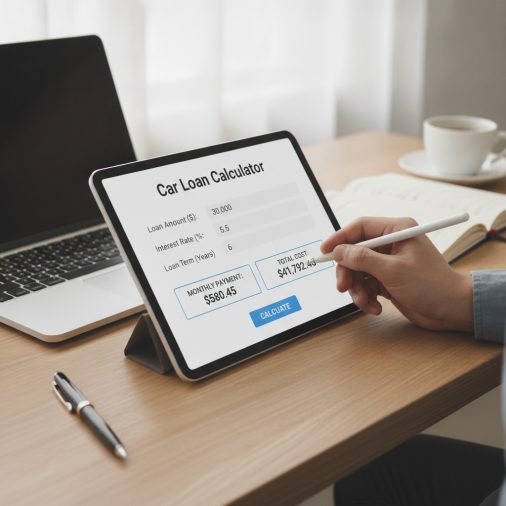
Follow these steps to get accurate results from the car interest calculator:
- Enter the vehicle price — type the full sticker or negotiated purchase price of the car.
- Enter your down payment — include any cash you plan to pay upfront at signing.
- Enter your trade-in value — if you are trading in a vehicle, enter its agreed value; leave at 0 if not applicable.
- Enter the APR — use the annual percentage rate quoted by your lender or dealer, not a monthly rate.
- Select the loan term — choose the number of months for your loan from the dropdown.
- Enter the sales tax rate — use your state or local rate; this is applied to the vehicle price before financing.
- Enter title, registration, and fees — include any dealer or government fees that will be rolled into the loan.
- Read your results — the calculator instantly shows your loan principal, monthly payment, total interest, and full out-of-pocket cost.
Understanding the Calculator Inputs
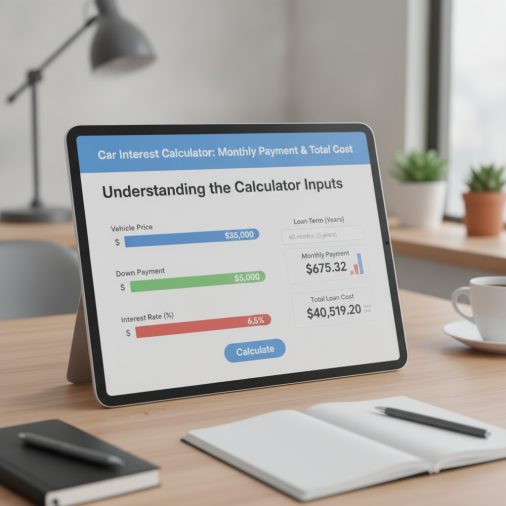
Vehicle Price ($): Enter the full negotiated purchase price of the car before any credits are applied. This is the number on the buyer’s order, not the MSRP sticker unless you are paying sticker price. For used vehicles, use the agreed sale price. The calculator applies sales tax to this figure, which is the standard method used in most U.S. states.
Down Payment ($): Enter the cash amount you will pay at signing. A larger down payment directly reduces the amount you need to borrow, which lowers both your monthly payment and the total interest you will pay over the life of the loan. Even an extra few hundred dollars upfront can meaningfully reduce your financing costs.
Trade-In Value ($): If you are trading in your current vehicle, enter the agreed trade-in credit here. Dealers typically apply this credit similarly to a down payment, reducing the amount financed. If you are not trading in a vehicle, leave this field at 0.
Annual Interest Rate / APR (%): Enter the annual percentage rate your lender has quoted or that you expect to qualify for. This is the yearly rate, not a monthly rate. The calculator converts it to a monthly rate internally. Rates vary widely based on your credit score, lender type, loan term, and whether the vehicle is new or used. Do not enter 0 — for near-zero promotional rates, use 0.01%.
Loan Term (months): Select the number of months over which you will repay the loan. Common terms are 48, 60, and 72 months. Shorter terms mean higher monthly payments but significantly less total interest. Longer terms lower your monthly payment but increase the total cost of the loan.
Sales Tax Rate (%): Enter your state or local sales tax rate for vehicle purchases. In most states, sales tax is calculated on the full vehicle price and then financed into the loan. Some states allow the trade-in value to reduce the taxable amount — this calculator uses the more common method of taxing the full vehicle price. Check your state’s DMV or revenue department for the exact rate.
Title, Registration & Fees ($): Include all dealer documentation fees, title fees, registration fees, and any other government charges that will be rolled into your loan rather than paid out of pocket at signing. These fees vary by state and dealer but commonly range from $300 to $1,500 or more.
Understanding Your Results
Loan Principal (Amount Financed): This is the actual dollar amount you are borrowing from the lender. It equals the vehicle price plus sales tax, minus your down payment and trade-in value, plus any fees rolled into the loan. This is the number your monthly payment and interest calculations are based on. Reducing this number — through a larger down payment or trade-in — is the most direct way to lower your total financing cost.
Monthly Payment: This is the fixed amount you will owe each month for the duration of your loan term. It is calculated using standard amortization, meaning each payment covers both interest and a portion of the principal. Early payments are weighted more toward interest; later payments pay down more principal. This figure does not include insurance, fuel, maintenance, or any other ownership costs.
Total Amount Paid: This is your monthly payment multiplied by the number of months in your loan term. It represents the total cash you will send to the lender over the life of the loan, not counting your down payment or trade-in.
Total Interest Paid: This is the total amount paid minus the loan principal — in other words, the pure cost of borrowing. This figure is one of the most important outputs because it reveals how much extra you pay simply for the privilege of financing the vehicle over time. Comparing this number across different loan terms and rates is a powerful way to evaluate your options.
Total Vehicle Cost (Out-of-Pocket): This combines your total loan repayment with your down payment and trade-in value to show the complete amount you will spend to acquire the vehicle. It is the most comprehensive measure of what the car truly costs you, and it is the number you should use when comparing financing scenarios side by side.
Interest as % of Vehicle Price: This expresses total interest paid as a percentage of the original vehicle price. It provides an intuitive sense of how much the financing adds to the cost of the car. For example, a result of 12% means you are paying 12 cents in interest for every dollar of vehicle price — a useful benchmark when comparing loan offers.
Calculation Formulas Explained
All calculations use the standard amortizing loan formula, which is the same method used by banks, credit unions, and auto lenders worldwide.
Step 1 — Loan Principal (P):
P = (Vehicle Price × (1 + Sales Tax Rate / 100)) − Down Payment − Trade-In Value + Fees
Sales tax is applied to the full vehicle price first, then down payment and trade-in are subtracted, and fees are added back. This reflects the most common U.S. financing structure.
Step 2 — Monthly Interest Rate (r):
r = APR / 1200
Dividing the annual rate by 1200 converts it from an annual percentage to a decimal monthly rate (dividing by 100 converts percent to decimal, then dividing by 12 gives the monthly rate).
Step 3 — Monthly Payment (M):
M = P × [r × (1 + r)^n] / [(1 + r)^n − 1]
Where n is the loan term in months. This formula ensures that each equal monthly payment covers the accrued monthly interest plus a portion of the remaining principal, so the balance reaches exactly zero at the end of the term.
Step 4 — Total Amount Paid: M × n
Step 5 — Total Interest Paid: (M × n) − P
Step 6 — Total Vehicle Cost: (M × n) + Down Payment + Trade-In Value
Step 7 — Interest as % of Vehicle Price: Total Interest / Vehicle Price × 100
Worked Example
Scenario: You are buying a used SUV priced at $28,000. You have $4,000 cash for a down payment and a trade-in worth $2,500. Your lender quotes 7.2% APR for a 60-month term. Your state sales tax is 6.5% and dealer fees total $650.
Step 1 — Calculate taxed vehicle price: $28,000 × 1.065 = $29,820
Step 2 — Calculate loan principal: $29,820 − $4,000 − $2,500 + $650 = $23,970
Step 3 — Calculate monthly interest rate: 7.2 / 1200 = 0.006
Step 4 — Calculate (1 + r)^n: (1.006)^60 = approximately 1.43204
Step 5 — Calculate monthly payment: $23,970 × (0.006 × 1.43204) / (1.43204 − 1) = $23,970 × 0.008592 / 0.43204 = $23,970 × 0.019888 = $476.61/mo
Step 6 — Total amount paid: $476.61 × 60 = $28,596.60
Step 7 — Total interest paid: $28,596.60 − $23,970 = $4,626.60
Step 8 — Total out-of-pocket cost: $28,596.60 + $4,000 + $2,500 = $35,096.60
Step 9 — Interest as % of vehicle price: $4,626.60 / $28,000 × 100 = 16.52%
This means you will pay $4,626.60 in interest over five years, and the vehicle will cost you $35,096.60 in total out-of-pocket spending — $7,096.60 more than the sticker price.
How to Interpret the Results
Monthly Payment: A common guideline is to keep your total monthly vehicle expenses (payment plus insurance) below 15–20% of your monthly take-home pay. If the monthly payment result exceeds that threshold, consider a larger down payment, a longer term, or a less expensive vehicle.
Total Interest Paid: This is the number most buyers overlook. A low monthly payment on a 72- or 84-month loan can hide thousands of dollars in extra interest. Always compare the total interest figure — not just the monthly payment — when evaluating loan offers.
Interest as % of Vehicle Price: As a rough benchmark, financing costs below 10% of the vehicle price are generally considered efficient for mid-range loan terms. Results above 20% suggest either a high interest rate, a very long term, or both — and may warrant shopping for a better rate or making a larger down payment.
Total Vehicle Cost: Compare this number to the vehicle’s expected value at the end of the loan. If the total cost significantly exceeds the vehicle’s projected resale value, you may want to reconsider the financing structure to avoid being underwater on the loan.
Comparing scenarios: Run the calculator multiple times with different APRs, terms, or down payment amounts to see how each variable affects your costs. Even a 1% reduction in APR or a $2,000 larger down payment can save hundreds or thousands of dollars over the life of the loan.
Common Mistakes to Avoid
- Focusing only on the monthly payment: Dealers often extend loan terms to make payments seem affordable, but this dramatically increases total interest. Always check the total interest paid result, not just the monthly figure.
- Forgetting sales tax and fees: Many buyers calculate based on the vehicle price alone and are surprised when the financed amount is thousands of dollars higher. Always include tax and fees in your planning.
- Using the interest rate instead of the APR: The APR includes certain fees and is the legally required disclosure for loan comparisons. Using a lower advertised interest rate instead of the APR will underestimate your true cost.
- Not accounting for the trade-in payoff: If you still owe money on your trade-in vehicle, the outstanding balance is typically added to your new loan, not subtracted. This calculator assumes your trade-in is owned free and clear or that the equity is positive.
- Assuming the dealer’s rate is the best available: Dealer financing is convenient but not always the cheapest option. Getting pre-approved by a bank or credit union before visiting the dealership gives you a benchmark rate to negotiate against.
- Ignoring the impact of add-ons: GAP insurance, extended warranties, and paint protection packages rolled into the loan increase your principal and the interest you pay on them. Evaluate each add-on separately before agreeing to finance it.
Limitations and Important Notes
This calculator uses the standard fixed-rate amortization formula and is designed for planning and comparison purposes. It assumes a fixed interest rate for the entire loan term; variable-rate auto loans will produce different actual payments over time. The calculator does not model GAP insurance, extended warranties, prepayment penalties, or dealer add-on products that may be rolled into a real loan.
Sales tax is applied to the full vehicle price before subtracting the down payment and trade-in, which is the most common method in the United States. Some states allow the trade-in value to offset the taxable amount — if your state uses this method, your actual tax and financed amount may be lower than shown. Always verify your state’s exact tax treatment with your dealer or state revenue department.
The calculator requires an APR greater than zero. For promotional 0% financing offers, the monthly payment is simply the principal divided by the number of months — you can verify this by entering a very small rate such as 0.01%.
Results are estimates for planning purposes only and do not constitute a loan offer, pre-approval, or guarantee of any financing terms. Actual loan amounts, rates, and payments will be determined by your lender based on your credit profile, the vehicle, and applicable laws. Always review your loan agreement carefully before signing.
Frequently Asked Questions
What is a good interest rate for a car loan?
A good auto loan rate depends heavily on your credit score, the loan term, and whether the vehicle is new or used. Borrowers with excellent credit (720 and above) typically qualify for the lowest rates, which can be in the low single digits for new vehicles from banks or credit unions. Borrowers with fair credit (580–669) may see rates in the 8–15% range, while subprime borrowers may face rates above 15%. Used car loans generally carry higher rates than new car loans because the collateral depreciates faster. The best strategy is to get pre-approved by at least two or three lenders before visiting a dealership so you have a competitive benchmark rate to work with.
How is a monthly car payment calculated?
Monthly car payments are calculated using the standard amortization formula: M = P × [r(1+r)^n] / [(1+r)^n − 1], where P is the loan principal (amount financed), r is the monthly interest rate (APR divided by 1200), and n is the loan term in months. Each monthly payment is the same fixed amount, but the split between interest and principal changes over time. Early in the loan, a larger share of each payment goes toward interest because the outstanding balance is high. As the balance decreases, more of each payment goes toward principal. This is why paying extra early in the loan term has a disproportionately large impact on total interest paid.
Does a larger down payment always save money?
In almost every scenario, a larger down payment reduces the total cost of financing. By lowering the loan principal, you reduce both the monthly payment and the total interest paid over the life of the loan. However, the savings depend on your interest rate and loan term. At a low APR over a short term, the interest savings from a larger down payment may be modest. At a high APR over a long term, the savings can be substantial. There is also an opportunity cost to consider — if the cash you would use for a down payment could earn a higher return elsewhere, the math may favor a smaller down payment in rare circumstances. For most car buyers, putting down at least 10–20% of the vehicle price is a sound financial practice.
Is it better to get a shorter or longer car loan term?
Shorter loan terms (36–48 months) result in higher monthly payments but significantly lower total interest paid. Longer terms (72–84 months) reduce the monthly payment but can cost thousands of dollars more in interest over the life of the loan. There is also a depreciation risk with long-term loans: vehicles lose value faster than the loan balance decreases in the early years, which can leave you owing more than the car is worth — a situation called being underwater or having negative equity. As a general rule, financial advisors recommend keeping auto loan terms at 60 months or fewer to balance affordability with total cost. Use this calculator to compare the total interest paid across different terms before deciding.
How does my credit score affect my auto loan interest rate?
Your credit score is one of the most significant factors lenders use to determine your auto loan interest rate. Borrowers with scores above 720 typically receive the best available rates, while those with scores below 580 may face rates several times higher. Even a 50-point difference in credit score can translate to a 2–4 percentage point difference in APR, which on a $25,000 loan over 60 months can mean paying $1,500 to $3,000 more in total interest. Before applying for an auto loan, it is worth checking your credit report for errors, paying down revolving balances, and avoiding new credit applications, all of which can improve your score and help you qualify for a better rate.
What is the difference between APR and the interest rate on a car loan?
The interest rate is the base cost of borrowing expressed as an annual percentage of the loan balance. The APR (Annual Percentage Rate) is a broader measure that includes the interest rate plus certain fees and costs associated with the loan, expressed as a yearly rate. For auto loans, the APR is the figure required by law to be disclosed to borrowers and is the most accurate number to use when comparing loan offers from different lenders. In practice, the difference between the interest rate and APR on a simple auto loan is often small, but it can be more significant if the lender charges origination fees or other costs. Always compare APRs — not just interest rates — when shopping for the best deal.
What fees are typically rolled into a car loan?
Several types of fees are commonly financed into an auto loan rather than paid upfront. These include dealer documentation fees (doc fees), which cover the paperwork and administrative costs of the sale; title and registration fees charged by the state; and sometimes sales tax, depending on the state and the buyer’s preference. Optional add-ons such as GAP insurance, extended service contracts, paint and fabric protection, and tire and wheel protection packages are also frequently rolled into the loan. Financing these extras increases your principal and means you pay interest on them for the life of the loan. It is generally better to pay fees and add-ons in cash if possible, or to decline add-ons you do not need, to keep your financed amount as low as possible.
Can I negotiate the interest rate at a dealership?
Yes, the interest rate offered through dealer financing is often negotiable, and dealers sometimes mark up the rate above what the lender actually requires — keeping the difference as profit. This is known as dealer reserve or rate markup. To negotiate effectively, get pre-approved for an auto loan from your bank or credit union before visiting the dealership. This gives you a concrete rate to compare against the dealer’s offer and signals that you are an informed buyer. If the dealer can beat your pre-approved rate, that is a genuine benefit; if not, you can use your pre-approval to finance the purchase. Some manufacturers also offer special promotional APR rates on new vehicles for qualified buyers, which can be significantly below market rates.